

Contents
My 15-Minute Radio Hit: The Music Industry’s War with AI Today
It began with chatbots. Then, artificial intelligence took over the realms of graphics and video. Now, the third wave has arrived: AI music. While the entry barrier for amateurs has plummeted to zero, this digital deluge is causing significant irritation – from enraged artists to ordinary listeners tired of the flood of low-quality content.
The End of Music As We Know It?
A Hit in Fifteen Minutes
As you scroll through social media platforms like TikTok, Instagram Reels, or Facebook, do you often encounter cringeworthy edits or trends that heavily feature AI-generated songs? If so, rest assured, you are not alone.
Of course, music created by artificial intelligence is not inherently new. It’s a natural progression of technological development. However, as a society, we’ve never before witnessed such an overproduction of AI-generated musical pieces.
Following this trend, two thoughts emerged in my mind: first, does the barrier to entry into the music world even exist anymore? And second, could a “musical illiterate” like myself create an AI song in just a few minutes?
Critics of AI music often argue that it isn’t “real” music because generating it requires no skill; the entire process supposedly boils down to a few clicks. However, my past experiences with “vibe coding” (a term often used in a similar context for programmers, suggesting simplified, click-based programming) remind me that sometimes reducing AI-related tasks to “a few clicks” can be an oversimplification.
How AI Music is Made: Becoming a Musician Without Playing a Single Note
So, I decided to take the plunge and join the ranks of aspiring artists creating AI music. Google and popular AI chatbots collectively pointed me towards Suno AI. I launched the platform, created a free account, and nothing stood in my way of creating. And if creating with AI, why not create *using* AI?
To minimize my effort, I asked Gemini to generate a prompt for Suno. First, I specified the musical style I was interested in, then asked for a short lyrical text for the track.
I copied the response into Suno, and indeed, I had a ready-made song, in four different versions no less!
With a stopwatch in hand, after setting up my account, creating a full-fledged song took me less than a minute. Writing the prompt for Gemini took about 10 seconds, transferring the response to Suno another 10 seconds, and then a few dozen seconds for processing. The result was ready. Here’s my first rap track, reminiscent of urban housing estates:

https://suno.com/s/XWbf9uXQk1OKHbcM
Naturally, this was a sprint attempt. When I started devising prompts myself, the creative process extended to about three or four minutes. The effect? Similar, because in my opinion, most AI songs just sound the same. Nevertheless, in this instance, I felt more like the “father of the success.”
The Alarming Conclusions
Does the creative process for AI songs truly boil down to the “meme-worthy” two keyboard clicks? To my surprise, yes. Suno, along with other generators, has completely demolished any entry barrier to the music world. Type two prompts, and you can enjoy your own music, and even potentially earn money if it catches an algorithm’s attention.
Of course, for significant success, it’s often easier to purchase a subscription package and explore additional options beyond just two prompts. But even then, creating AI music might only take twenty minutes and a modest investment of a few dollars.
Frankly, not long ago, I hardly believed claims that creating AI music was so simple. Yet, when I tried my hand at it, I realized the music industry faces a significant challenge, as these tools will only continue to improve (and they are already very good).
Democratization or Degradation? What AI Offers Amateurs
Let’s be honest: for someone whose guitar skills don’t extend beyond basic chords, music generators are a dream come true – a chance to be a rock star without enduring the arduous stage of “years of practice and bleeding fingertips.” Tools proudly bearing the AI label offer us what psychologists call instant gratification.
- Want to write an epic, heavy metal track with dark themes? Three clicks, and you have it.
- Need a personalized background track for a holiday vlog to ensure YouTube’s algorithm doesn’t penalize your reach due to copyright? No problem; artificial intelligence will spit out pleasant lo-fi beats faster than you can take a guitar out of its case.
It’s pure fun playing god of sounds, where the only limitation is our imagination or the ability to string together coherent sentences in a prompt window. The problem is that this supposed democratization of art carries a hefty and rather indigestible burden. When everyone can be a composer, it suddenly turns out that… no one truly is.
Mass-generated music by amateurs suffers from one fundamental flaw: a chronic lack of uniqueness. It’s functional, high-grade sonic fast food. Everything sounds technically correct, production is clean, vocals are in tune, but ultimately, it’s auditory junk food.
It goes in one ear and out the other, leaving no lasting impression. We are witnessing the birth of a culture where, instead of unique masterpieces, we create perfectly tailored, plastic background noise for scrolling social media. Is this degradation? For purists, probably. For the rest of the world? Well, just another free time-filler.
How Professionals Utilize AI
At this point, professional musicians might enter the room, clad in white, holding banners proclaiming the “death of the human soul.” But when the cameras are off and a project needs to be finished yesterday, many of them quietly fire up the same algorithms. Because, contrary to popular belief, many professionals don’t view AI as a soulless invader threatening their livelihoods (though some vociferously protest), but rather as a reliable, digital assistant.
Even legends like Paul McCartney admit that AI is simply another tool in the musical arsenal – sometimes the only way to complete something that seemed lost forever.
When creating The Beatles’ last song, McCartney used AI-powered source separation technology to isolate John Lennon’s vocals from a murky, old demo recording. As he himself admitted in an interview with the BBC:
We were able to take John’s voice and get it pure through this AI, so then we could mix the record as you would normally do. So it gives you some kind of leeway.
Is AI a Cure for Creative Block?
Imagine you have writer’s block – you’ve been sitting in front of your monitor for five hours, and the only thing you can manage is a melancholic C major chord. In such a moment, an algorithm acting as an infinite generator of random ideas looks quite appealing.
You don’t ask it for a finished track. You ask for twenty strange, alternative chord progressions or an unusual melody line for a brass section. You treat AI like a peculiar but brilliant bandmate who throws out hundreds of absurd ideas a minute. Most are nonsense, but one in a hundred turns out to be the missing piece of your next hit.
Beyond creativity, there’s also simple efficiency and time savings. Instead of manually spending three days removing noise from vocals recorded in poor conditions, a professional producer launches an AI plugin that does it in seconds. Need to separate drums from an old 70s sample? The algorithm will break down the track into its constituent parts faster than you can even think about it. For the music industry, artificial intelligence is simply a revolution on par with the calculator in an accounting office – no one wants to do manual calculations anymore when a machine does it flawlessly.
The Deluge: Streaming Algorithms Overwhelmed by 100,000 New Tracks Daily
And here we reach a turning point. Welcome to the era of massive cluttering of the streaming space. This phenomenon has already earned its own charming name: AI slop, or digital mush. Every day, hundreds of thousands (yes, hundreds of thousands) of tracks generated in bulk by bots land on Spotify, Apple Music, and other platforms.
Does that sound like an exaggeration? Let’s look at hard data from industry reports. According to analytics firm Luminate, an average of 106,000 new tracks are uploaded to streaming services daily. How much of this is digital junk spewed out by bots?
While Spotify prefers not to disclose exact figures (although they officially admitted to removing as many as 75 million spam tracks from their database in just one year), the platform Deezer has started openly sharing statistics.
Their official communications indicate that AI detection systems are already catching nearly 75,000 fully AI-generated tracks daily. This means algorithms are responsible for over 44% of all new music landing on the service!
How does it work? Clever “creators” set up account farms, generate countless thousands of hours of bland playlists labeled “music to study,” “relaxing rain pop,” or “lo-fi beats,” and upload them, hoping you’ll fall into the algorithm’s trap. You just want to quietly read a book with background music, and meanwhile, fractions of cents for plays trickle into the account of some clever programmer on the other side of the world. The business thrives, but in the process, recommendation algorithms go completely haywire.
In a comment provided to our editorial team, Spotify’s press office emphasized that the platform is constantly developing systems to detect and limit spam and manipulative content – regardless of whether it was created using artificial intelligence or other methods. Representatives of the service stress that the priority remains protecting user experience, the integrity of the entire ecosystem, and supporting authentic artist creativity.
Nevertheless, due to this deluge of soulless junk, finding anything fresh, authentic, and created by a living human online today borders on a miracle. Places for listening to music are slowly turning into digital landfills, where plastic, mass-produced mush replaces genuine culture.
We are fed the musical equivalent of instant noodles – seemingly warm, with some flavor, but in the long run, it’s not good for us and provides no nutritional value.
Importantly, Spotify’s press office acknowledged that the issue of labeling AI-generated tracks is complex and constantly evolving. The company argues that as the largest streaming platform, it does not want to introduce hasty, universal solutions. Instead, it collaborates with industry partners to develop standards for disclosing the use of artificial intelligence in metadata and creator descriptions, and to further develop systems for detecting AI-generated spam.
Spotify’s press office also confirmed that, in the AI era, building trust in the authenticity of creators is of particular importance. The platform indicates that it is developing solutions allowing users to better get to know artists, for example, through the “Verified by Spotify” badge, which is not an assessment of music quality but a confirmation of meeting specific criteria regarding activity and profile authenticity. Spotify is also developing new sections presenting creator context and song information, while emphasizing that the recommendation system remains primarily based on personalization. The goal of these actions is both to facilitate the discovery of new music and to better showcase human creativity, building lasting relationships between listeners and artists.
Why Live Concerts are the Salvation for Music (and Video)
Does all this mean we are doomed to the ultimate collapse of pop culture and will soon be mourning the demise of true artists? Not necessarily. Paradoxically, this entire flood of artificiality could be a positive development. All indications are that we are heading for a brutal but very healthy market segmentation.
On one hand, we will have cheap and ubiquitous background music. Algorithms can completely take over elevators, supermarkets, dentist waiting rooms, and backgrounds for makeup videos. And that’s fine – no one was really listening to the lyrics there anyway. On the other hand, a powerful renaissance of “live” music awaits us.
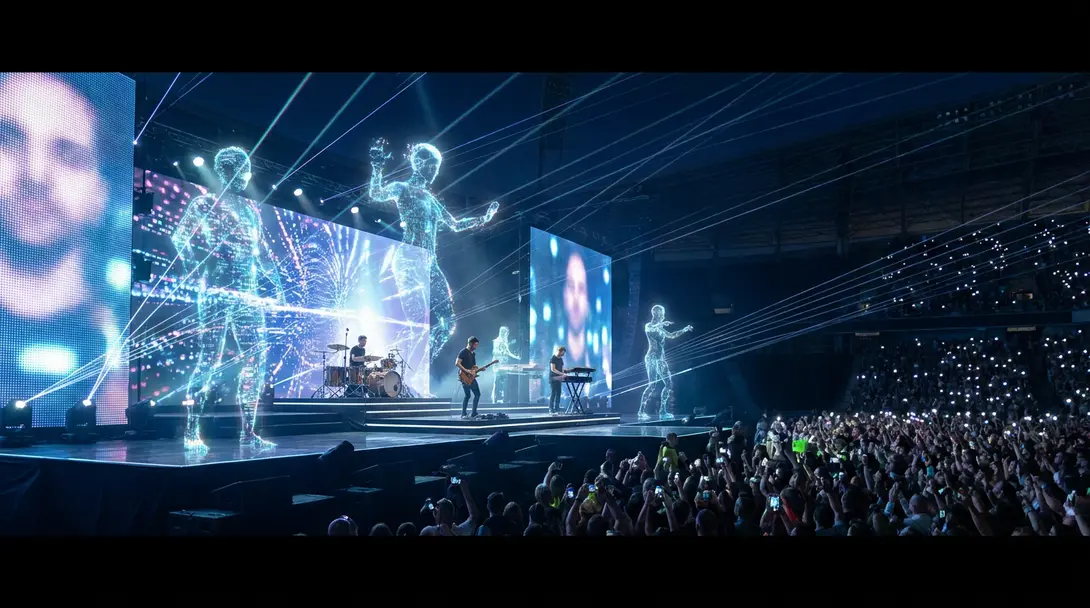
The more sterile, perfect, and generated the internet becomes, the more we, as humans, will yearn for imperfection, rawness, and genuine emotion. We will want to see someone sweating on stage, forgetting lyrics, throwing a guitar to the ground, and conveying emotions that no Large Language Model (LLM) can simulate. This highlights the AI authenticity dilemma.
The exact same thing awaits the world of video. When generators like Sora or Runway eventually inundate us with perfect, digital films about everything and nothing, authenticity will become the currency of the future. We will prefer to watch a crookedly shot vlog, hand-held, featuring a real, tired person, over a Hollywood blockbuster spewed out by AI.
The salvation for culture, therefore, lies in a return to tangibility. Artificial intelligence can generate billions of songs a day, but as long as it can’t step onto a stage and captivate a massive stadium audience with its performance, we are safe.
Frequently Asked Questions (FAQ)
AI has lowered the barrier to music creation, allowing amateurs to produce tracks with minimal effort. While this democratizes creation, it also raises concerns about originality, as many AI-generated songs sound similar and lack the unique artistic depth found in human-made music. The sheer volume of AI content can devalue music as a whole, turning it into “digital mush” or background noise.
Streaming platforms are struggling with the massive volume of AI-generated content, with tens of thousands of new tracks uploaded daily. While they are developing systems to detect and remove spam, they also acknowledge the complexity of identifying AI content and are working with industry partners to establish standards for disclosure. Spotify, for instance, focuses on protecting user experience, ensuring ecosystem integrity, and supporting authentic artists, while also developing features like “Verified by Spotify” to build trust in creators.
Yes, it is highly likely. As digital content becomes increasingly sterile and “perfect” due to AI generation, there will be a growing human desire for authenticity, imperfection, and genuine emotion. Live concerts and performances offer an experience that AI cannot replicate – the raw energy of a human artist, their mistakes, and their direct emotional connection with the audience. This makes live events a crucial antidote to the digital deluge and a sanctuary for human artistry.
Source: Original Research. Opening photo: Gemini
About Post Author
