Contents
Disneyland Through a Geek’s Eyes: Where Technology is Indistinguishable from Magic
Volvo presented an extraordinary challenge: drive their all-electric EX90 model from Warsaw to Paris – specifically, to Disneyland. As one of the world’s most renowned amusement parks, Disneyland is packed with fascinating technologies and remarkable engineering solutions. From the perspective of a technology enthusiast, I’m excited to share my impressions.
Our journey led us to spend two days at Disneyland Paris. Our goal was to peek beneath the layers of fairytale decorations and understand how the attractions work, whose true mechanisms are meant to remain invisible to the guest.
It quickly became clear that Disneyland isn’t merely a collection of rollercoasters. It’s a cohesive system encompassing attractions, restaurants, hotels, shops, a dedicated app, and a meticulously planned guest flow. It designs not only what you see but also the sequence in which you experience emotions and make decisions.
Disneyland might just be the most brilliantly designed machine for spending money ever created. Yet, the most interesting part is that you’ll likely leave feeling absolutely delighted.
The Disney Imagineering Philosophy: Blending Imagination with Engineering
Many traditional amusement parks, despite boasting impressive, record-breaking rollercoasters, often present these as standalone steel or wooden structures built on a concrete plaza. The entire experience typically hinges on extreme physical sensations – G-forces and sudden changes in speed and height. These attractions are primarily designed by engineers and programmers.
Disney approaches this differently. When Walt Disney built his first park in Anaheim, California, he established an elite division within his company called Disney Imagineering. This clever name is a portmanteau of two English words: Imagination and Engineer.
Imagineers were, in essence, multi-talented artisans who combined engineering capabilities with artistic vision and a deep understanding of human emotions and psychology. The core idea was for each attraction to transport guests to a different world, immersing them in a meticulously crafted story. This philosophy is why a rollercoaster that might be a relatively inexpensive, family-friendly ride with quick turns in other parks can become a project worth hundreds of millions of euros at Disneyland.
For a deeper dive into Disney’s creative process and the magic behind its stories, you might find this review of the Disney+ Light & Magic series insightful.
Big Thunder Mountain: Where Technology Serves the Story
Big Thunder Mountain is a classic Disney rollercoaster where the entire structure “disappears” within its narrative. Disney constructed an artificial lake, an island on the lake, a mountain on the island, and then cleverly concealed a steel rollercoaster within it. Passengers board a mining train on the shore, then pass through an underwater tunnel to reach the main track.

Along the way, they encounter caves, stalactites, waterfalls, and machinery that looks as if miners abandoned it decades ago. The wood is deliberately aged, metal is made to appear rusted, and the modern construction is covered with a controlled patina to enhance the illusion.
Beneath these elaborate decorations, however, operates an ultra-modern system. Big Thunder Mountain utilizes a dual station and can run five trains simultaneously. Thanks to highly efficient computers and thousands of diverse sensors, the attraction can accommodate over 2,400 passengers per hour.
The track is divided into independently secured sections. A subsequent train can only enter a segment once the system confirms that the previous train has safely exited it. This solution mirrors railway signaling logic: high throughput is achieved not by compromising safety, but by precisely controlling the position of every train.
Yet, guests aren’t meant to think about blocks, sensors, or brakes. They are meant to believe they are riding a speeding steam train through an abandoned mine. This is one of the most crucial principles of Walt Disney Imagineering: technology is not the main character. It must remain invisible, serving only to enhance the narrative.
This approach extends beyond theme parks. In a car, technology shouldn’t constantly demand attention. The best systems operate in the background: monitoring the surroundings, assisting the driver, and reacting when needed, but without turning every journey into a demonstration of computing power.
Our journey from Warsaw to Paris in the all-electric Volvo EX90 showcased this principle. The Volvo EX90 exemplifies an attempt to reconcile a multitude of sensors and driver-assistance systems with a simple, serene interior and stress-free travel.
Flight Force: Manipulating Senses in the Dark
Flight Force, a rollercoaster set in the Marvel universe, employs an entirely different method of sensory control. The rollercoaster is enclosed within an enormous hangar, whose true scale is only appreciable from outside the park or via satellite imagery. From the pathway, guests only see a futuristic facade of the Avengers training center. The industrial building is completely hidden, and the true size of the attraction is masked by a precisely designed and told story.
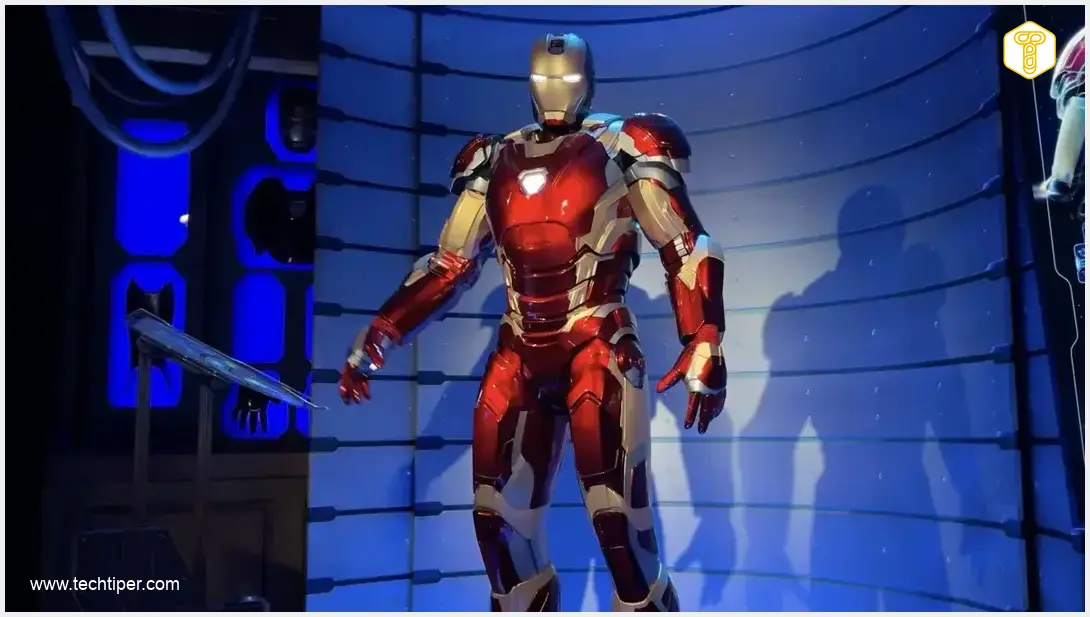
While queuing for the attraction, a robotic Iron Man briefs guests on the mission they are about to undertake. Even with long wait times, park visitors don’t get bored, as Disney builds anticipation and excitement long before the actual ride begins.
Once the mission starts, the lights dim, and the train accelerates from zero to nearly 100 km/h (about 62 mph) in under three seconds. This isn’t achieved with a traditional chain or cable but rather through what’s colloquially known as an electromagnetic launch. More technically, it uses a linear synchronous motor (LSM).
In simplified terms, imagine an electric motor cut open and laid out along the track. Successive coils create a moving magnetic field that pulls and accelerates the train. However, the most interesting tool for designers here isn’t the advanced technology itself, but rather… the absence of light. When we can see the track and the horizon, our brain can predict upcoming turns or drops. In Flight Force, our vestibular system senses the G-forces, but our eyes receive insufficient information to quickly regain orientation. We only have sound design, flashing lights, and massive screens hidden at specific points within the hangar. All of this is designed to make us feel like superheroes on an interplanetary mission alongside Iron Man.
Disney doesn’t always have to reinvent physics. Sometimes, it takes an existing mechanism and meticulously designs everything that influences its perception: the story, sound, lighting, and the amount of information reaching our senses.
The electric drive was also a key highlight of our journey to Paris. The Volvo EX90 uses an 800V architecture, and the manufacturer claims a charging time of approximately 22 minutes to go from 10% to 80% battery capacity. During our trip, we found that at fast charging stations, the car was usually ready for the next leg of the journey before we had even finished our break. Volvo specifies a charging power of 350 kW, and we even managed to achieve 377 kW.
The tested EX90 variant featured two motors generating a combined 680 horsepower. These figures allow the large, family-sized SUV to accelerate from 0 to 100 km/h (62 mph) in just 4.2 seconds. Consequently, the electromagnetic launch on the Flight Force rollercoaster wasn’t quite as astonishing to us, because driving the Volvo EX90, we could experience a similar sensation every time we pressed the accelerator pedal.
Any Sufficiently Advanced Technology Is Indistinguishable From Magic
A classic drop tower has a relatively simple design: a gondola with passengers is pulled up dozens of meters, a lock is released, creating a momentary sensation of weightlessness, and a braking system safely dissipates energy before reaching the ground. Disney could have placed a similar machine on a concrete slab. Instead, they built a decaying, abandoned hotel where only an emergency, service elevator for employees remained operational.
According to widely cited estimates, the Tower of Terror attraction cost approximately 180 million euros (about 193 million USD). The hotel appears as if its prime was Hollywood in the 1930s. Plaster is cracked, suitcases are abandoned, and the staff doesn’t act like ride operators. They are actors, portraying hotel personnel frozen in 1939. The experience begins in the reception area. Guests then pass through a library, learn the story of missing guests, and descend into a dark boiler room, from which they enter the service elevator. Before the cabin even moves, Disney spends several minutes building tension.
The biggest behind-the-scenes curiosity is that the attraction’s vertical system was designed by the Otis Elevator Company. This is a company whose logo many of us might see in a typical apartment building or office. Otis’s primary task is to design elevators that move as smoothly as possible. Here, Otis was given the opposite challenge: the elevator ride was meant to be unforgettable. The elevator moves in darkness, plummeting with immense acceleration between various random floors. On each floor, a new element of the story unfolds through optical illusions and practical special effects.
Interestingly, the cabin isn’t simply released and left to gravity. Motors and a cable system control its movement in both directions. This allows passengers to be pulled downwards faster than gravity alone would accelerate them. The use of a seatbelt, identical to those in a regular car, intensifies the feeling of danger and excitement. Disneyland is not just fairytales, to put it mildly. And when the passenger exits, full of adrenaline, they are led past photos taken at the most exhilarating moment and directly into a gift shop.
Disney, therefore, doesn’t just design attractions. It designs a sequence: first emotion, then the opportunity to purchase a memento of that emotion.
Ratatouille: The Adventure – Trackless Technology and Sensory Immersion
Ratatouille, the beloved animated film about a charming rat who dreams of becoming a chef, inspired an attraction that attempts to alter our sense of scale. Guests board a vehicle resembling a rat, and everything around them becomes enormous: doors, dishes, food products, and kitchen fragments. The illusion engages multiple senses simultaneously. Physical decorations transition into projections, the vehicle rotates to align with the on-screen action, and at appropriate moments, gusts of air, water droplets, temperature changes, and even scents are introduced.
However, the vehicle itself remains the most intriguing element. It doesn’t move along visible tracks. It has its own propulsion system, and a positioning system along with elements embedded in the floor allow its precise control. In a simplified sense, it resembles a giant robotic vacuum cleaner that transports passengers instead of dust. The vehicles can rotate, split apart, and regroup according to the attraction’s scenario. This isn’t just about removing a visible track; the system allows designers to position guests at precisely the angle needed to experience the next element of the story.
Here, technology directs not only the movement of the machine but also the attention of the people within it. For this attraction, Disney patented numerous new technological solutions – for example, an in-floor charging system that recharges the vehicles in mere seconds while passengers are disembarking and boarding. This innovative approach to power delivery offers a fascinating parallel to real-world advancements in wireless charging for electric vehicles, highlighting how cutting-edge technology can be seamlessly integrated into everyday experiences.
Disney Dining: Transforming a Meal into an Experience
At Disneyland, a three-course dinner can cost anywhere from 45 to 60 euros (approximately 48 to 65 USD). However, we’re not talking about ordinary restaurants. Most are integral to the storytelling and an extension of a particular attraction.
After the Ratatouille attraction, we dined at Bistro Chez Rémy, where the illusion of being shrunken continues. Chairs resemble gigantic champagne corks, plates act as room dividers, and a dessert might look like a piece of cheese but is actually a sweet fruit confection. Food surprises with its form at every turn.
A similar mechanism operates at PYM Kitchen, adjacent to the Flight Force rollercoaster. In this case, instead of a three-course meal with waiter service, there’s a buffet inspired by the Pym Particles from the Ant-Man storyline. In the film, these particles were used to enlarge and shrink people and objects – in service of humanity. The restaurant’s narrative is a variation on this idea: instead of chefs, there are scientists, and instead of a kitchen, an experimental laboratory. The scientists, instead of focusing on important research, experiment with food in their free time, offering guests familiar dishes in abnormally huge or microscopic sizes. While the food itself was decent, its quality alone would struggle to justify the price of around 45 euros (about 48 USD) per person.
At Disneyland, you’re not just buying a meal. You’re buying another scene from the story, an opportunity for a photo, and an extension of the emotions experienced after leaving an attraction. A meal that becomes an epilogue to a ride is a masterpiece of monetization. The guest doesn’t have to leave the themed world, compare prices, or interrupt the story. The most convenient choice keeps them within the Disney ecosystem.
Disney Hotels: Selling Time, Not Just Accommodation
After the first day, we didn’t leave the Disney bubble. We stayed at Disney Hotel Cheyenne, themed as a Wild West town. Cowboy wagons, wooden buildings, and “Toy Story” details continued the narrative even after leaving the park. A package for two people, including one night’s stay, park tickets, and meals, cost around 1,000 euros (approximately 1,075 USD). It’s important to note that this wasn’t just the price of the room. Nevertheless, without the Disney-themed decorations, the standard of accommodation would be hard to justify for such a significant portion of the budget.
However, the greatest value of a Disney hotel isn’t necessarily the room or breakfast. It can be time. Guests of Disney hotels can take advantage of “Extra Magic Time,” which allows them to enter one or both parks an hour before their official opening. This enables them to experience some of the top attractions before queues stretch to dozens of minutes. Throughout the day, visitors can also purchase Disney Premier Access, providing access to shorter queues for selected attractions. Disney has thus created several tiers of convenience, allowing guests to reclaim the most scarce resource in the park: time. Formally, you buy accommodation. In practice, you buy time.
Time and fatigue were equally important resources during our journey to France. We covered approximately 800 kilometers (about 500 miles) daily, so not only the EX90’s performance but, crucially, its comfort mattered. The pneumatic suspension, cabin sound insulation, and available massage functions in the seats ensured that after a full day behind the wheel, we still had the energy to create our content. The EX90 can transport up to seven people. Traveling as a pair allowed us to utilize the generous space differently: by folding down the seats and throwing in a mattress, the car transformed into a makeshift camper. This clearly demonstrates that technological advancement doesn’t solely mean impressive specifications. It should translate into convenience, space, and practical applications for long journeys.
The Myth of “Go Away Green”: Disney’s Masterful Use of Subtlety
Disney excels at attracting attention but is equally meticulous in designing elements that should remain unnoticed. The internet frequently circulates a story about a specific, supposedly patented color called “Go Away Green.” The legend claims the park paints technical areas, doors, trash cans, and fences with this color to make them virtually invisible.
The reality is less magical but far more interesting. It’s not about one miraculous shade, but rather a family of muted greens and browns carefully selected to blend with their surroundings. The color doesn’t make an object vanish. It merely reduces contrast and prevents it from competing for our attention with a facade, lighting, or movement nearby. The most fascinating aspect is the systemic approach. Designers not only highlight the most important element of a scene but also all the things that are intended to remain in the background. At Disneyland, attention is guided by architecture, perspective, sound, lighting, movement, scale, and sometimes, simply by a deliberately unexciting paint color.
Disney’s Contributions to Robotics and AI: Bringing Characters to Life
Disney’s latest showcase of technological prowess is World of Frozen. Here, designers aim to transport the animated Arendelle into the physical world. Mountains obscure attraction buildings, the castle’s scale is enhanced by forced perspective, vegetation is chosen to evoke a Scandinavian landscape, and facades incorporate motifs from Norwegian folklore.
In the Frozen Ever After attraction, the key elements are the boats, projections, light, sound, and a new generation of Audio-Animatronics. An Audio-Animatronic isn’t just a “moving doll.” Inside, there’s a mechanical skeleton with drives and controllers that must repeatedly reproduce movements synchronized with music and the position of passing guests. The Parisian version, however, also features something unique: a free-roaming, robotic Olaf created by Walt Disney Imagineering Research & Development. This character can move its eyes, mouth, arms, and even its detachable carrot nose.
Creating this robot presented an unusual problem. Olaf has spherical feet, the proportions of an animated character, and a walking style that doesn’t need to obey the laws of physics on screen. In the real world, he must maintain balance, not only while walking through the park but also during shows where he performs on a rocking boat. Instead of manually programming reactions to every possible tilt, the team utilized deep reinforcement learning. The robot repeatedly practiced in a simulated environment, receiving feedback on which behaviors helped it maintain balance.
Disney is developing its own GPU-accelerated simulator, Kamino. This is the company’s contribution to the open-source Newton framework, created in collaboration with NVIDIA and Google DeepMind. The system is designed to enable the training of multiple simulated robots simultaneously, shortening the path from an animated character to its physical counterpart. An engineer sees processors, drives, simulation, and artificial intelligence. But a child… sees Olaf.
A similar approach to technology guided our entire journey. Advanced solutions don’t hold value simply because they look good on a specification sheet. They gain value only when they solve a real problem. In Olaf’s case, it’s preserving the character of an animated figure in a physics-bound world. In the case of the Volvo EX90, it’s safely, comfortably, and as seamlessly as possible covering a long distance in an electric car.
Disneyland’s Ultimate Technology: The Entire Park as a System
Does Disneyland truly control us? Not in the sense of hypnosis or depriving us of free will. We can choose not to buy a photo, eat outside the park, select a different hotel, or stand in a regular queue.
However, Disneyland meticulously designs the conditions under which we make these decisions. It directs attention using light, sound, movement, and set design. It plans the sequence of emotions, from building anticipation to the gift shop at the exit. It integrates hotels, tickets, apps, restaurant reservations, and early park access into one convenient system. It also removes from view everything that might interrupt the story.
This is why, for two days, we had almost no reason to leave this carefully constructed bubble. We ate in Ant-Man’s laboratory and the rat’s restaurant. We slept in the Wild West. In the morning, we leveraged access to the rarest resource: time. Awareness of these mechanisms doesn’t have to diminish Disneyland’s magic. From a tech enthusiast’s perspective, it can even increase admiration. Only then do we begin to understand how much mechanics, robotics, perceptual psychology, safety systems, and experience design are required for a steel rollercoaster to appear like an old mine, or for a machine to become a beloved character from a film.
We arrived in Paris in the electric Volvo EX90 as part of a challenge prepared by the Volvo brand, a project partner. The route from Warsaw to Disneyland and a full technological analysis of the park were also showcased in video materials.
Disneyland’s greatest achievement isn’t a single robot, rollercoaster, or elevator. It’s the comprehensive system that makes all these elements feel like part of one, authentic world. Similarly, the best way to evaluate a technologically advanced car isn’t by the number of systems and processors, but by whether, during a long journey, the technology removes obstacles, reduces fatigue, and allows you to focus on your destination. In our case, that destination was Disneyland, and the Volvo EX90 proved to be more than just a means of transport – it became an integral part of the entire technological expedition.
Frequently Asked Questions (FAQ)
Disney Imagineers blend engineering skills with artistic creativity and a deep understanding of human psychology to craft immersive experiences. They meticulously design every detail, from the visual aesthetics to the emotional arc of a story, often hiding advanced technology to ensure it serves the narrative rather than distracting from it.
The “Go Away Green” concept is not a single patented color but rather a strategic use of muted greens and browns chosen to blend seamlessly with the environment. This systematic approach ensures that background elements like utility doors, fences, or maintenance areas do not draw attention, allowing guests to focus on the main themed attractions and storytelling.
Disney extends its storytelling into dining and accommodation by making restaurants and hotels integral parts of the themed experience. For example, restaurants like Bistro Chez Rémy or PYM Kitchen continue the narrative of nearby attractions, using decor, food presentation, and even character interactions to immerse guests further. Hotels like Hotel Cheyenne extend park themes, and value-added services like “Extra Magic Time” (early park access) leverage technology and logistics to offer guests more precious time in the parks.
Disney is at the forefront of animatronics and robotics, as exemplified by the free-roaming robotic Olaf. This advanced character uses deep reinforcement learning, where it practices in simulated environments (like Disney’s Kamino simulator, developed with NVIDIA and Google DeepMind) to master complex movements and maintain balance in dynamic conditions. This allows for highly realistic and interactive character experiences that seamlessly integrate into the park’s physical world, ensuring technology remains invisible while enhancing the magic.
Source: Łukasz Skałba / Android.com.pl
Opening photo: Łukasz Skałba / Android.com.pl
About Post Author