

Contents
The Future of Sports: How Technology and AI Are Redefining Competition and Fan Experience
Technology loves sports, and sports loves technology. Yet, fans often remain deeply traditional, resistant to changes in rules that have stood for decades. However, they must adapt—technology is fundamentally altering how we experience sports. But what will the landscape look like in 2049? Will technology strip sports of its soul?
Sport: Evolution or Revolution?
Imagine this scenario: a fouled striker’s cry, a referee’s whistle, and a pointer to the penalty spot. A penalty kick seems imminent. But wait—the referee receives an alert, prompting them to approach a monitor and review the foul replay from various angles. Thirty seconds, then sixty, then ninety pass. The verdict is in: the striker wasn’t fouled at all; they merely exaggerated a poor dribble with a flimsy dive. The VAR (Video Assistant Referee) system has just saved one team from conceding an “unjust” goal.
Today, such a scene surprises no one. Technology has become an integral part of every sport, from football to volleyball and snooker. Yet, just over two decades ago, athletes, coaches, and fans had to place boundless trust in the referee’s eyes and ears.
We once had a human official; today, we have a human integrated with technology. Will we advance further in this evolution in another two decades, by 2049, perhaps seeing an AI referee?
Of course, in the context of sports, discussions about technological intervention aren’t limited to officiating. New technologies also leave their mark on how we watch sports on television, how athletes train, the stadium experience, and the entire ecosystem surrounding major global sporting events. But let’s start with the basics—what happened two decades ago.
2003: A Look Back at Simpler Times
Let’s take a brief trip back in time to 2003—a year when Real Madrid was assembling its “Galácticos” by signing David Beckham. Roman Abramovich was transforming the football world by acquiring Chelsea, Cristiano Ronaldo moved from Sporting to Manchester United, Adam Małysz dominated ski jumping, Michael Jordan played his final NBA game, LeBron James was drafted, Roger Federer won his first Wimbledon, and Michael Schumacher became F1 World Champion for the sixth time.
Having indulged in a bit of nostalgia, we can now look at those times with a more critical eye. Few remember that matches, competitions, and races were primarily watched through highlights back then. Globally, broadcast rights for sports events were not always highly sought after. If they were, competitions were often viewed in 4:3 aspect ratio on snowy CRT televisions.
Streaming was virtually nonexistent, and the internet was still in its infancy. All information about sporting events came from newspapers, television, and radio. While sport itself was already modernizing, no one envisioned introducing VAR systems, goal-line technology, or any AI-powered referee assistance.
Scandals like the “Battle of Old Trafford” or the chaos at the Brazilian Grand Prix would today be analyzed by hundreds of cameras and dozens of officials, with relevant sporting bodies imposing additional fines on the athletes involved.

Today, officials strive to prevent the kind of technical chaos seen in 2003.
Sport two or three decades ago differed from today not only in broadcast technology but also in the approach to athlete preparation. Footballers trained in heavier, less breathable uniforms made mostly of thick polyester or cotton. Boots were stiffer and less ergonomic, and protective gear was often minimal.
In Formula 1, drivers used far less advanced safety systems, and telemetry data analysis was incomparably poorer than it is today. Sport functioned more intuitively and “analogically”—without GPS, smart sensors, sleep monitoring, or algorithms analyzing every athlete’s movement. Today, even amateur athletes can access technologies that professionals from the early 2000s couldn’t even dream of.
While we don’t want to diminish the magic, atmosphere, and aura of those times, sport was undeniably more “primitive” and “raw” back then compared to today. So, what about now?
2026: The Era of Commercialization
If 2003 was “primitive” and “raw,” then sport in 2026 is “commercialized to the extreme.” For athletes, officials, and coaches, this means greater earning opportunities, but it’s not necessarily good for fans, who are often inundated with mediocre spectacles or simply fleeced of their money.
It’s easy to criticize organizations like FIFA and UEFA for expanding the World Cup and European Championships to an absurd scale. In upcoming tournaments, we’ll see teams from nations like Uzbekistan, Jordan, or Curaçao—teams with no realistic chance of success. Critics argue that such teams lower the tournament’s overall quality, though these same people might later marvel at stories of semi-professionals scoring against footballing giants. Organizers readily use this narrative, explaining changes as “opening doors” for smaller federations. In practice, however, it’s primarily about business—more teams mean more matches, and more matches mean greater profits.
Yes, sport is commercializing at an unprecedented pace; athletes are products, and clubs and national teams also measure their marketing strength. But ultimately, what still matters is who scores the goal, who completes a lap faster, and who makes a three-pointer.
Sport at Your Fingertips
We can watch sports anywhere and however we want. The Olympic Games, World Cups, Champions League, NBA, Formula 1—all these competitions have their homes on leading broadcasters and streaming services. And in 2026, we can watch sports on TV, computers, laptops, tablets, and phones. All that’s required is a stable internet connection. Highlights and key moments instantly spread across YouTube, Instagram, TikTok, Facebook, and X.
We consume sports through a hybrid of linear television and streaming. Some sporting events are accessed directly on VOD services, while others are still watched on traditional TV channels.
Innovations Essential for Viewing
Beyond commercialization, another fitting description for today’s sport is “over-engineering,” particularly regarding how sporting events are presented. Every major competition is packaged with dozens of special programs broadcast by various channels and online platforms. Added to this are mountains of statistics, graphs, and analyses, which even coaches sometimes struggle to navigate.
Imagine being completely new to football; it’s no longer enough to know what offside is. Now, experts and fans discuss half-spaces, field thirds, diagonal passes, and the xG model. This theoretically helps viewers better understand why a player made a particular decision or why a coach made a certain substitution. On the other hand, for many fans, this is an unnecessary complication of what should be simple entertainment.
As we stand on the cusp of an AI revolution (or perhaps are already in its midst), artificial intelligence is also making its way into sports. Line judges at Wimbledon, for example, have experienced this firsthand. Sony developed Hawk-Eye technology, which uses AI to instantaneously inform the main umpire whether a ball has landed in or out of bounds. This advancement has effectively displaced human workers, who have been replaced by an algorithm.
In the context of technology development used by officials, we cannot forget football, which is becoming a primary battleground between tradition and modernity. We are all familiar with VAR systems, goal-line technology, SAOT (Semi-Automated Offside Technology), and slow-motion replays shown from fourteen different angles.
All these innovations have been implemented in recent years, and many more are on the way. This season, a groundbreaking novelty is the small cameras equipped on match referees. This allows fans to enjoy replays from a unique perspective—that of a participant in the on-field action.
Officials in other sports also utilize various technological innovations. In tennis, it’s the aforementioned Hawk-Eye. In volleyball, the Challenge system has been successfully operating for years, and 4K cameras showing ultra-slow motion imagery allow us to verify “micro-touches.” In cricket, highly sensitive directional microphones are used to detect the sound of the ball hitting the bat, with the umpire seeing a sound graph synchronized with video footage.
Formula 1, meanwhile, operates with a “virtual control tower” in Geneva, overseeing every race—regardless of whether drivers are competing in Brazil, Spain, or Japan. A similar system is in place in the NBA, where the referee operations center is located in Secaucus, New Jersey.
A Touch of Kitsch
Unfortunately, the world of sports increasingly employs AI in a rather kitschy way, often tied to current trends and social media. Not long ago, there was a discussion about a concerning trend observed during the Winter Olympic Games. Such uses of AI for sports promotion are definitely something we want to avoid.
In summary—sport has never been more commercialized. This state of affairs has enormous advantages but also (often) ethical drawbacks. If you’re a casual fan, the ethical concerns might not resonate as much. What is primarily appreciated is the ease with which you can now watch a Champions League final anywhere in the world. We also appreciate that competitions are theoretically fairer, thanks to technology supporting officials. And finally, we appreciate the athletes themselves, who, by leveraging technological and scientific advancements, are several athletic levels above their counterparts from 50 years ago.
2049: More, Stronger, Faster, Better?
We’ve covered 2003, moved through 2026, and now it’s time for 2049. To grasp the scale, in 2049, football star Robert Lewandowski will be 61 years old, and tennis ace Iga Świątek will be 48! This raises the first question: Will these two be able to sit in a studio before the 2050 World Cup final or a Wimbledon championship match and unreservedly compare their on-field and on-court achievements to their successors?
After all, it’s often said that athletes from the 1970s or 1980s cannot hold a candle to today’s competitors. One might hear claims that a player like Pelé would struggle to dribble past an average defender from a top-tier league, or that Arnold Schwarzenegger wouldn’t even be among the top contenders in Mr. Olympia finals.
However, going further, it’s equally popular to hear predictions that artificial intelligence will completely displace real athletes from the industry. I don’t believe this will happen. But I consulted an expert—Adam Pawlukiewicz, a sports analyst and director of Pentagon Research. He holds a similar view, believing that artificial intelligence will not push footballers off the pitch, basketball players off the court, or rally drivers off the tracks. However, this doesn’t mean that AI won’t become even more deeply intertwined with sports.
“In 2050, artificial intelligence and big data will be perceived differently than they are now. However, I don’t expect them to predict precise outcomes. If they did, sport would become a computer game, human emotions would be killed, and thus the psychological aspect of sport would vanish. That won’t happen. Just as theatre and books will endure, so too will ‘human’ sport. There will be probabilistic models to aid in predicting results (sports betting) and monitoring an athlete’s bodily functions, but they will certainly not dominate the characteristics of psychological mechanisms.”
—Adam Pawlukiewicz, Director of Pentagon Research
This perspective highlights the enduring value of human unpredictability and psychological drama in sports. For a deeper dive into how AI is influencing management roles across industries, exploring both acceptance and anxiety, you might find this article insightful.
What Will AI Do in 2049?
So, where exactly will artificial intelligence “dig in”? I can imagine AI being regularly used by officials. Tools could help interpret disputed situations, analyze who first or last touched the ball, and calculate important results, times, and statistics live. Broadcasters would certainly be keen to use such solutions. Specialized programs are already emerging that overlay filters onto broadcasts to analyze, for example, player movement on the field. In two decades, such features could be commonplace in every sports broadcast.
Athlete Training as an Algorithm
Focusing on the athletes themselves, a significant trend is evident: professional athletic training is becoming a kind of algorithm. Breakfast at a specific time with a precise number of carbohydrates and proteins. Gym sessions planned down to every repetition and kilogram of weight. Main training optimized by GPS, sensors, sleep monitoring, HRV (Heart Rate Variability), micro-recovery cycles, and so on. Scientists and coaches discover new, more effective training methods almost monthly. As a result, in 23 years, an athlete’s daily training could be precisely calibrated not by a team of people, but by a single individual working in collaboration with AI—from start to finish.
The contemporary model of professional athlete preparation has undergone a radical transformation—from an individual relationship with a coach to working within broad, integrated expert departments. In the analysis “High-performance sport management: Case studies of successful programmes” by Paul Reid and Bob Stewart, it is noted that success in high-performance sport ceased to be solely the result of a coach’s intuition and became the outcome of managing a complex support system (Interdisciplinary Support Teams).
The authors emphasize that while 20-30 years ago a support staff might have been limited to a coach and perhaps a physiotherapist, today it’s standard to have an army of specialists in biomechanics, data analytics, clinical dietetics, or neurobiology. All of this allows for precise optimization of marginal gains. Furthermore, evolution has forced a change in the role of the coach, who, from being the sole substantive authority, has become a “performance manager,” coordinating the work of a multi-person team to minimize the risk of error and maximize the athlete’s physiological potential through strict specialization.
This evolution in sports mirrors a broader societal debate about the role of technology in human endeavors. The increasing reliance on data and algorithms in sports raises questions about authenticity and human imperfection, a dilemma explored further in this discussion on AI and authenticity.
“Technological Doping” vs. Traditional Doping
Amidst this influx of technological innovations, a problem arises that we can provisionally call “technological doping.” What about regulating gadgets like exoskeletons, recovery aids, or even bionic modifications? While this sounds like a scenario from a cyberpunk game, such issues could arise, for instance, in the Paralympics, where athletes often use various prostheses.
A popular saying goes, “There are no athletes who don’t take substances, only those who don’t get caught.” Regardless of whether we agree with this, pharmacology is also advancing and may soon provide illegal, yet undetectable, performance-enhancing substances. And then there are biological, neurological, regenerative, and even algorithmic enhancements. This represents one of the darker sides of technological development.
“To some extent, the ethical problem exists already. Technology for illicit enhancement is already significantly ahead of the ability to detect prohibited substances and processes. It will be a constant race.”
—Adam Pawlukiewicz, Director of Pentagon Research
The evolution of anti-doping systems has led to a situation where, despite a massive increase in the number of controls, the official detection rate of banned substances has paradoxically decreased. What does this mean in practice? Primarily, it points to the effectiveness of masking methods. A comparative analysis of IOC data from 1990 and WADA reports from 2022 shows that the number of tests conducted increased from approximately 71,000 to over 256,000 annually, but the percentage of positive results decreased during that time from 1.33% to 0.77%.
No One Replaces Humans, Especially in Sports
The clamor of technological novelties also brings back the discussion about the future of athletes themselves. Here, I agree with Adam Pawlukiewicz—there’s no chance that a duel between two robots will ever be more exciting than a contest between two humans, dripping with sweat, blood, and tears.
“There is no such possibility, because then all emotions would disappear, and without them, there would be no sport. People would be left with artificial substances to induce emotional states. Some might find that appealing. A dozen years ago, it was predicted that media would suppress the desire for ‘live’ viewing. Meanwhile, we are seeing a great return of spectators to stadiums and other venues for sporting events (like the Olympics). Technology only helps, and even more so, it ignites the desire to see and experience it live.”
—Adam Pawlukiewicz, Director of Pentagon Research
Immersive broadcasts, such as those shown in football matches, only serve to enhance this live experience, making the human element even more compelling.
New Disciplines on the Horizon?
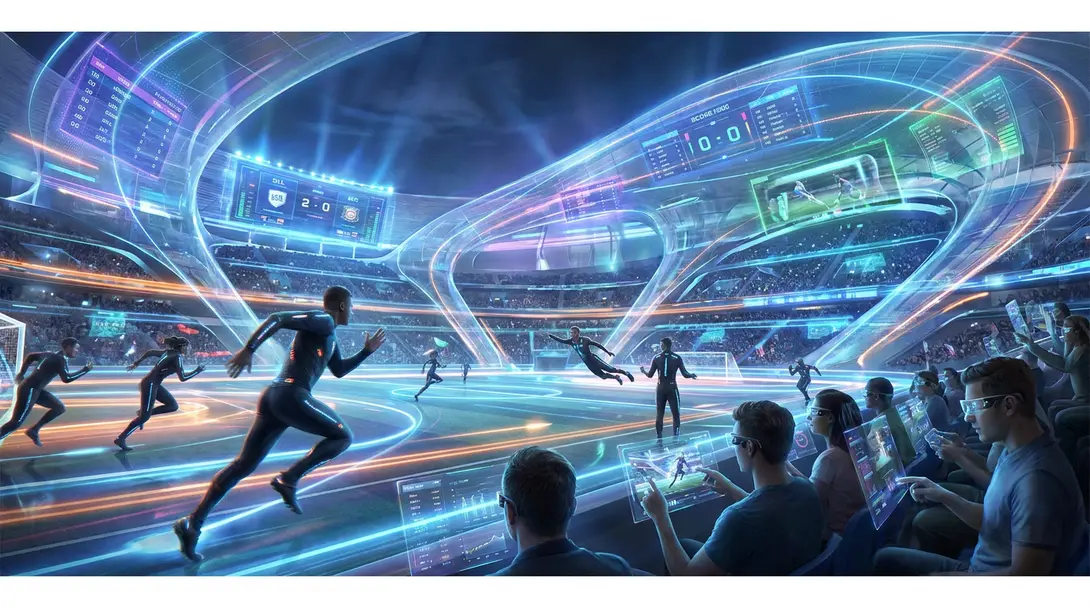
Looking at the evolution of sport, it’s clear that major booms often arise from a combination of spectacle, the internet, and youth culture. In the 1990s, MMA was a niche and brutal curiosity; today, UFC events are among the biggest sporting spectacles globally. By 2049, disciplines combining the digital and physical worlds could follow a similar path—for example, professional VR leagues, augmented reality sports, or hybrids of esports and traditional physical competition. Competitions where athletes simultaneously compete physically and operate in digitally generated environments seem increasingly probable.
It’s also possible that the future of sports will favor shorter, more dynamic, and “internet-friendly” competition formats. Younger generations consume content faster than ever before, which is why disciplines designed for social media—with short durations, high intensity, and immediate viewer gratification—hold immense potential. Just as MMA evolved from niche fights into a global media product, completely new sports based on spectacular one-on-one duels could emerge by 2049.
Satisfying the Fan: Mission: Impossible?
What should sport be? Should it be maximally fair? Maximally spectacular? Or maximally profitable? New technologies can help achieve an appropriate balance. The more precise, measurable, and optimized sport becomes, the more frequently we must answer an uncomfortable question: do we want ideal sport, or human sport?
Ultimately, the entire history of sport boils down to emotions and human errors. Without these errors, we wouldn’t have Diego Maradona’s “Hand of God,” because the referee would have correctly disallowed the play. We wouldn’t have Muhammad Ali’s legendary knockouts, because his opponents would have maintained a tighter guard. And we wouldn’t have our Adam Małysz, because his rivals would have withstood the pressure of competing against the “Eagle from Wisła.”
Even today, with stadiums, tracks, courts, and arenas equipped with dozens of cameras, entire teams of people overseeing events, and athletes in peak physical condition… these errors still occur. And it’s hard to believe that what hasn’t changed for hundreds of years will suddenly transform within two decades—even with AI support.
Where is Technology Leading Sports?
In 2049, will the next Lionel Messi be an autonomous Tesla robot? There’s no chance. It would simply be too perfect. Every shot would be a goal, every race would be won by the best algorithm, and every referee’s whistle would be beyond reproach. Meanwhile, sport is a game of these very errors.
We hate these errors, we often cry because of them, sometimes they benefit us, but without them, sport would be meaningless. In all of this, however, we must remember the inequalities. Already today, the entry barrier to even the simplest physical activities is incredibly high.
Meanwhile, in two decades, this gap could widen, and to step onto a pitch, we might need not just shoes and a ball, but an entire “young athlete’s kit” that Nike or Adidas wants to sell us. Sport has always been about pushing one’s limits—more goals, faster cars, more knockouts.
But is this truly technology’s role? We want more, but at the same time, we still want it to be natural and noble, like the first ancient Olympic Games in 776 BCE—a group of people competing against each other to be the best. Simple, right? This simplicity is the most beautiful part of it, and it wasn’t shaken by the Gutenberg press, the discovery of electricity, nor will it be by the development of artificial intelligence.
Android 2049 is a series about our future prepared in collaboration with the Copernicus Science Centre and SWPS University.
Frequently Asked Questions (FAQ)
AI systems like VAR (Video Assistant Referee) in football and Hawk-Eye in tennis are already integral to modern sports, assisting officials in making more accurate and consistent decisions. These technologies provide multi-angle replays, instant data, and precise measurements, significantly reducing human error and enhancing the perception of fair play. However, they also introduce new debates around decision-making speed and the human element in sports.
Advanced technologies pose significant ethical dilemmas, especially concerning “technological doping.” This refers to performance enhancement through means like exoskeletons, bionic modifications, or highly advanced recovery aids that could provide an unfair advantage. Such advancements blur the lines between natural ability and artificial augmentation, raising questions about equity, the integrity of competition, and whether it fundamentally alters what it means to be an athlete. The challenge lies in regulating these technologies to maintain a level playing field and preserve the essence of human competition.
Experts largely agree that human athletes are unlikely to be replaced by AI or robots in professional sports. While AI can optimize training, analyze performance, and assist with officiating, the core appeal of sports lies in human emotion, unpredictability, and the drama of imperfection. The struggle, the triumph, and the occasional error are what captivate audiences. As sports analyst Adam Pawlukiewicz states, without human emotions, sport would become a “computer game,” losing its psychological depth and appeal.
By 2049, the fan experience is expected to be hyper-immersive and highly personalized. We can anticipate even more sophisticated broadcast technologies, including virtual reality (VR) and augmented reality (AR) overlays that allow fans to experience games from a player’s perspective or access real-time data directly. Social media integration will be seamless, and new interactive formats could allow fans to influence aspects of the viewing experience. Despite these advancements, the enduring desire to experience sports live in stadiums is also projected to continue, with technology enhancing rather than replacing the in-person event.
Yes, it is highly probable that new hybrid digital-physical sports will emerge and gain significant traction by 2049. Following the trajectory of disciplines like MMA, which evolved from niche to global phenomena, future sports could blend virtual reality, augmented reality, and traditional physical competition. These could include professional VR leagues, AR-enhanced physical challenges, or esports formats that require significant physical exertion. Such innovations are likely to cater to younger generations’ preferences for dynamic, high-intensity, and social media-friendly content.
Source: Self-developed content.
Opening photo: Gemini
About Post Author
