

Contents

Isuzu D-Max Arctic Trucks AT35: Unrivaled Off-Road Capability with Factory Warranty
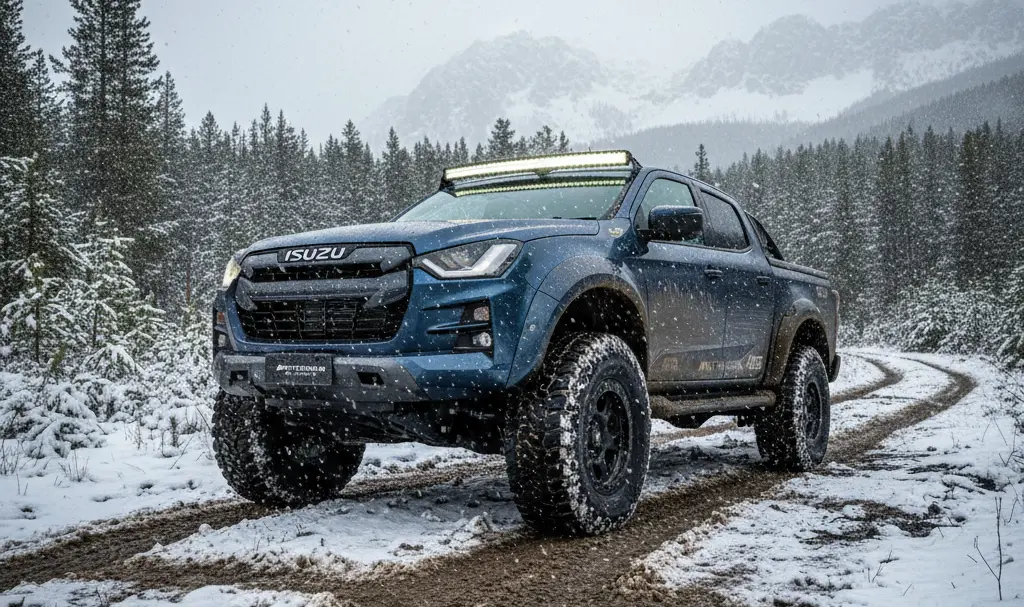
We’re embarking on another test of the Isuzu D-Max, but this time with the specialized Arctic Trucks (AT35) package. This significant modification transforms the pickup into a vehicle capable of venturing much further off-road. Crucially, this is a nearly factory-approved modification, meaning you won’t void your warranty when driving it off the dealership lot – a common concern with such extensive changes. Join us as we dissect the Arctic Trucks concept and explore what makes this D-Max truly exceptional.

Isuzu D-Max Arctic Trucks AT35 Review: Contents
- Pricing and Equipment of the Isuzu D-Max Arctic Trucks AT35
- Insurance Costs
- Technical Specifications of the Isuzu D-Max Arctic Trucks
- What is Arctic Trucks? A Brief Overview
- Multimedia System
- Interior of the Isuzu D-Max Arctic Trucks
- Elevated Driving Experience
- Cargo Bed with Special Enclosure
- Driving Impressions of the Isuzu Arctic Trucks
- Driving Dynamics
- Fuel Consumption and Range of the Isuzu D-Max Arctic Trucks
- Driver Assistance Systems
- Summary and Our Opinion
Pros and Cons
Advantages
- Arctic Trucks modifications retain Isuzu’s 5-year warranty.
- Factory-approved modifications effectively conquer tough terrain.
- D-Max maintains decent on-road manners for daily driving.
Disadvantages
- The biggest drawback is the lack of a power upgrade.
- Modifications performed outside of Arctic Trucks will likely be cheaper.
Our Opinion: Isuzu D-Max Arctic Trucks AT35
The Arctic Trucks package is unique in the market, as it’s hard to find another offering that delivers genuine off-road capability while retaining the factory warranty and full functionality of all technologies. The Isuzu D-Max gains immensely, though not in all areas. Particularly noticeable is the D-Max’s power deficit, as this aspect remains untouched by the modifications.
Pricing and Equipment of the Isuzu D-Max Arctic Trucks AT35
When considering the Isuzu D-Max Arctic Trucks, it’s important to understand that while it’s a modification, it’s not entirely factory-built. It’s carried out by an external company, but everything is compliant with homologation standards and approved by Isuzu itself. Therefore, the pricing and equipment levels are identical to those of the standard Isuzu D-Max. The amounts listed below are net prices in USD (excluding tax):
Isuzu D-Max Base Models (Net Prices)
- Single Cab (L):
- Rear-wheel drive: ~$38,425
- All-wheel drive: ~$43,025
- Extended Cab (1.5, 4×4):
- L: ~$45,200
- LS: ~$47,650
- LSX: ~$51,950
- LSE: ~$53,800
- Double Cab (4×4):
- L: ~$47,650
- LS: ~$49,175
- LSX: ~$53,500
- LSE: ~$55,325
To these prices, you must add the cost of the Arctic Trucks package, which is approximately ~$12,500 (net). The exact amount may vary depending on the specific scope of work. The standard equipment for individual D-Max variants is comprehensive and designed for durability.
Warranty Retention – A Key Advantage
One of the most crucial aspects of the Arctic Trucks modification is that you do not lose your warranty. You can still benefit from Isuzu’s 5-year, factory warranty (up to 62,000 miles), which covers paintwork. Furthermore, you can report potential issues related to body perforation for 12 years.
Estimated Insurance Costs for Isuzu D-Max
According to insurance data, basic liability (OC) insurance for a tested D-Max for a driver with several years of experience might cost around ~$167.50 annually. A full coverage package including comprehensive (AC) could cost approximately ~$1,025. These are estimates, and actual costs will vary.
The basis for the Arctic Trucks modification in our test Isuzu is a fully equipped D-Max Double Cab in the LSE version. Additional optional equipment included: metallic gray paint (~$800 net), an aluminum bed enclosure (DC, ~$3,275 net), and a rubber bed liner (~$575 net).
This brings the total to approximately ~$49,625 net (~$61,025 gross). However, at the time of publication, a promotion was available, bringing the final Isuzu price to approximately ~$44,625 net (~$54,875 gross). Adding the Arctic Trucks package, which costs just under ~$12,500 net, we are looking at a vehicle that costs nearly ~$62,500 net, or over ~$75,000 gross without discounts (around ~$8,750 gross in savings).
Technical Specifications of the Isuzu D-Max Arctic Trucks
The standard Isuzu D-Max already offers robust technical specifications. However, the Arctic Trucks variant introduces several key changes primarily focused on enhancing off-road capability. The Arctic Trucks AT35 boasts impressive improvements:
- Approximately 20% increased ground clearance.
- Approach angle: 35 degrees.
- Departure angle: 29 degrees.
Naturally, this also leads to a higher curb weight of approximately ~4,850 lbs (2.2 tons). Since the engine power remains unchanged, performance is inherently limited, which we’ll discuss further below. The specific modifications included in the Arctic Trucks AT35 package for our test vehicle are:
- AT 315/70 R17 all-terrain tires.
- 17×10″ “ARCTIC TRUCKS” aluminum wheels.
- Painted fender flares.
- Special, dedicated side steps.
- Speedometer calibrator (essential due to larger tires).
- Front suspension lift of approx. 40 mm (1.57 inches).
- Rear suspension lift of approx. 40 mm (1.57 inches).
- 20 mm (0.78 inches) body lift.
- Bumper, fender, and wheel arch trimming.
- Torque wrench, dedicated for 17/10 wheels.
- Four original “ARCTIC TRUCKS” mud flaps.
- Additional front bull bar with an installed LED light bar.
- Additional engine skid plate.
- Wheel balancing.
- Suspension alignment.
- Technical inspections after modification.
What is Arctic Trucks? A Brief Overview
Arctic Trucks is an Icelandic company specializing in comprehensive vehicle modifications for extreme off-road conditions, significantly improving their capabilities. The brand’s history dates back to the early 1990s when a Toyota division in Iceland spun off to form a separate company. From its inception, Arctic Trucks has focused on modifying pickups and SUVs.
While our focus is on the Isuzu D-Max, Arctic Trucks’ offerings extend beyond it. They also prepare modifications for Toyota Hilux models and previous generations of the Toyota Land Cruiser (150 series). In other countries, they offer packages for vehicles like the Nissan Navara, Land Rover Defender, or VW Transporter, showcasing their broad expertise.
Despite the modifications, the Isuzu D-Max Arctic Trucks (AT35) still falls within the Segment I (pickup) category. However, considering its extreme off-road capability, its primary factory-offered competitor is the aforementioned Toyota Hilux (also available with an Arctic Trucks package). The Ford Ranger Raptor is another contender, though it represents a slightly different off-road philosophy focused on high-speed desert running.
Multimedia System: Isuzu Remains Isuzu
The Arctic Trucks modification does not alter the Isuzu D-Max’s operating system, meaning you get the exact same software as the standard model. This translates to a straightforward system that focuses on basic functionalities, without advanced features or localization for specific languages. While not the most sophisticated system, it proved adequate for the vehicle’s intended purpose during our tests.
A detailed description of the Isuzu D-Max’s multimedia capabilities can be found in a full review of the standard model. It’s worth noting that the 7-inch digital instrument cluster serves as an equally, if not more, important control panel for vehicle settings than the 8-inch central display, often mirroring key driving options.
The central touchscreen features a clear interface with basic personalization options. Despite occasional lag and responsiveness issues, its operation is simple and intuitive, which is paramount. Combined with physical shortcut buttons, essential functions are quickly accessible. Physical climate control buttons are also present, a welcome feature.
A significant advantage of the Isuzu’s software is the presence of wireless Android Auto and Apple CarPlay. A factory navigation system is absent, which can be seen as a benefit if the development time was instead invested in other areas of vehicle performance.
The digital instrument cluster is paired with several analog gauges. However, in less expensive versions, a smaller onboard computer screen is used. Crucially for the Isuzu D-Max Arctic Trucks, the modifications do not hinder the operation of any systems; the speedometer accurately indicates true speed (e.g., 140 km/h displayed corresponds to 134 km/h via GPS), and other assistance systems function without issues.
Interior of the Isuzu D-Max Arctic Trucks: Practically Unchanged
Stepping inside the tested Isuzu D-Max Arctic Trucks, you’d be hard-pressed to find significant differences between it and the factory model. This is another area where changes are limited to just a few minor details. Therefore, all previous assessments of the D-Max’s interior from standard model reviews remain largely valid.
The addition of the modified bed enclosure, which is an Isuzu accessory rather than an Arctic Trucks modification, doesn’t change the keyless entry system. This system still only applies to the cabin and its two pairs of doors. The cargo bed has its own separate locking mechanism, requiring a physical key, which is integrated with the enclosure’s additional doors.
Stepping Up and Finding a New Switch
The most noticeable change resulting from the Arctic Trucks modification is undoubtedly the raised suspension. You’ll need to lift your leg considerably higher to get into the Isuzu D-Max cabin. The modified steel side step actually helps here, as it has been reduced in size and raised to avoid compromising longitudinal ground clearance (ramp angle) off-road.
A- and B-pillar grab handles remain invaluable for entry and exit. However, children or shorter individuals will find it more challenging to reach them. Everything else, including door opening mechanisms, trim, and overall interior design, remains unchanged.
So, where should you look for differences? Firstly, there’s no point in using the rearview mirror due to the tall bed enclosure. Secondly, there’s a new button located near the driver’s left knee. Toggling this switch activates the powerful LED light bar, which illuminates the road in conjunction with the high beams.
The rest of the interior is identical: a functional, somewhat rugged, but well-built pickup cabin primarily designed for work. While the “piano black” accents could benefit from alternative finishes, practical solutions dominate, which is the most important aspect of the D-Max’s cabin.
Cargo Bed Features a Special Enclosure with Lighting
The tested Isuzu D-Max was equipped with a bed enclosure that isn’t just a simple tonneau cover, but a full hardtop. While this naturally limits the transport of tall items and obstructs rearview mirror visibility, it significantly increases secure, enclosed cargo space. The additional side and rear doors are equipped with gas struts and independent locks, so remembering to secure them with the key is essential.
Access to the bed is otherwise similar, though you’ll need to lift items higher due to the increased ground clearance and operate the separate enclosure doors. Arctic Trucks does not specify any change to the D-Max’s payload capacity. While the suspension is modified, it’s not explicitly reinforced for heavier loads. Therefore, it’s prudent to subtract the enclosure’s weight (approximately ~440 lbs / 200 kg) from the standard payload, limiting total loading to around 2,000 lbs (900 kg).
Moreover, the enclosure includes cargo area lighting with three settings (dim, bright, off). This dramatically improves visibility not only for your cargo but also for the area around the D-Max when the doors are open. The setup is complemented by mounting grids for additional accessories. Finally, the test pickup can still be fitted with a tow hitch, capable of pulling 7,700 lbs (3.5 tons).
Driving Impressions of the Isuzu Arctic Trucks: You Won’t Need a Tractor
The modified, higher suspension and large, aggressive all-terrain tires directly translate to the Isuzu D-Max Arctic Trucks performing significantly better in challenging off-road conditions. While the standard D-Max already performs well on rough terrain, the increased ground clearance and more aggressive tread allow it to conquer deeper and softer obstacles with ease.
On the other hand, these modifications do impact daily driving on paved surfaces. You’ll need to account for the increased dimensions (height and width) and expect additional road noise at higher speeds. However, for the most part, the driving experience maintains the general characteristics of a classic pickup.
The steering system didn’t require modification, as the factory setup already provides substantial power assistance. This, combined with the tall and wide 35-inch wheels, works flawlessly. Maneuvering presents no major issues, as even the turning circle remains similar (around 41 feet / 12.5 meters). Naturally, at higher speeds, you’ll notice reduced precision, but this isn’t necessarily a unique characteristic of the Arctic Trucks modifications.
Regarding the suspension, the increased ground clearance of the AT35 compared to the standard D-Max is a game-changer. The cabin itself is lifted (20 mm body lift), the larger wheels contribute, and the suspension is raised by an additional 40 mm. All this means you sit much higher, can navigate larger ruts, and achieve greater axle articulation. In this regard, the D-Max Arctic Trucks is one of the most capable off-road vehicles we’ve ever tested.
In practice, all these changes are palpable and invaluable off-road. Tymczasem w codziennej jeździe… żadne krawężniki i poprzeczne nierówności (na czele z progami zwalniającymi) nie są nam straszne, aczkolwiek czujemy je we wnętrzu. Isuzu zachowało odpowiednią sztywność, aby nie wychylać się nadmiernie w zakrętach, choć siłą rzeczy nie myślmy o dynamicznej jeździe.
In practice, all these changes are palpable and invaluable off-road. Meanwhile, in daily driving… no curbs or transverse unevenness (especially speed bumps) are a problem for us, although we do feel them inside. Isuzu has maintained appropriate stiffness to prevent excessive body roll in corners, although dynamic driving is naturally not the priority.
P.S. Under the bed, you’ll find a road-spec spare wheel, without an all-terrain tire.
Driving Dynamics of the Isuzu D-Max Arctic Trucks: You Can’t Cheat Physics
The most significant oversight in the Arctic Trucks modification is the untouched engine. This means that in a pickup weighing over ~4,850 lbs (2.2 tons), the available power is a modest 163 hp (360 Nm / 265 lb-ft) from a 1.9-liter diesel engine. This is paired with a 6-speed automatic transmission and a low-range transfer case, which we’ll discuss shortly.
With unchanged factory power, you must expect compromised performance. A standard D-Max typically accelerates from 0-60 mph (0-100 km/h) in just over 12 seconds; during our tests, it sometimes took over 13 seconds. The Arctic Trucks version, however, requires at least 14 seconds for the same sprint. This was the best result, with more typical times closer to 16 seconds, especially considering the winter conditions during our test.
While Arctic Trucks comprehensively modifies the D-Max’s suspension, other off-road aspects of the Isuzu remain unchanged. This means you still have selectable 4-wheel drive (2H, 4H), the aforementioned low-range transfer case (4L), and a rear differential lock. What else could Arctic Trucks consider? For complete perfection, besides more power, a winch would be a valuable addition.
Undoubtedly, in off-road conditions, the tested pickup performs excellently where high torque or technical driving with traction is crucial. However, greater power could further transform this vehicle’s capabilities, especially on steep ascents where its limits are quickly reached.
On paved roads, the Isuzu D-Max Arctic Trucks will naturally be slower, requiring more throttle input to maintain urban speeds. This contributes to higher fuel consumption, which we’ll address next. Drivers must also factor in the vehicle’s increased width and height during city driving (particularly in parking lots). Beyond these aspects, it’s not a vehicle that requires special driver preparation.
Naturally, purchasing an Isuzu D-Max Arctic Trucks solely for occasional off-road excursions defeats its primary purpose; its true calling is extreme off-roading. However, nothing prevents you from driving it in the city or on highways.
Suburban scenarios are still entirely manageable for the Isuzu. Things get more challenging on expressways and highways, where not only road noise becomes more prominent, but you’ll again feel the need to plan all overtaking maneuvers more carefully. Additionally, remember to load the bed; after the suspension lift and the addition of all-terrain wheels, the rear axle benefits from extra weight to maintain traction.
Overall, the automatic transmission performs quite well. It feels as though it might have been reprogrammed, tending to hold higher RPMs and shift gears later. It does so relatively smoothly, though the engine’s sound will be a constant companion. This approach, however, maintains appropriate driving fluidity without delays or incorrect gear selections.
Finally, it’s important to remember that the D-Max is not exceptionally soundproofed from the factory. The diesel engine (with average refinement) is clearly audible in the cabin, and above 37 mph (60 km/h), the hum of the all-terrain tires becomes noticeable. This noise increases exponentially with speed, and on highways, it’s definitely worth slowing down, as at 87 mph (140 km/h), the cabin is simply loud.
Fuel Consumption and Range of the Isuzu D-Max Arctic Trucks: Weight Takes Its Toll
The Arctic Trucks modification does not alter the powertrain itself, starting with its fuel supply; the fuel tank capacity remains 20 gallons (76 liters). The start-stop system is still present, though it never activated during our tests, likely due to the low ambient temperature (around 23°F / -5°C) and the onboard computer indicating a need to charge the 12V battery.
Winter weather, additional weight, and the aggressive tread of larger all-terrain tires all contribute to higher fuel consumption for the Isuzu D-Max Arctic Trucks. To provide realistic results, we added approximately ~440 lbs (200 kg) of cargo to the bed for our measurements. Keep in mind that a diesel engine can take up to 6 miles (10 kilometers) to fully warm up.
In the city, with very calm and smooth driving, it’s possible to achieve 31.36 MPG (7.5 L/100km), but this is an exceptional scenario. Most of our city trips resulted in figures around 21.38 MPG (11 L/100km), giving an estimated range of ~430 miles (~690 km). However, if you’re in a hurry, stuck in traffic, or encounter numerous red lights, the onboard computer can easily show as low as 15.68 MPG (15 L/100km).
Outside the city, the Isuzu feels much more at home, as it doesn’t constantly strain the diesel engine and can maintain a consistent speed (around 50 mph / 80 km/h). In these conditions, the D-Max Arctic Trucks achieves around 33.6 MPG (7 L/100km), offering an impressive estimated range of ~670 miles (~1080 km). On highways and expressways, however, the diesel engine again has to work harder:
- 60 mph (100 km/h): 27.68 MPG (8.5 L/100km) – Range: ~550 miles (~890 km)
- 75 mph (120 km/h): 23.52 MPG (10 L/100km) – Range: ~470 miles (~760 km)
- 80 mph (130 km/h): 20.81 MPG (11.3 L/100km) – Range: ~415 miles (~670 km)
- 87 mph (140 km/h): 17.82 MPG (13.2 L/100km) – Range: ~355 miles (~570 km)
These figures indicate that the fuel consumption of the Isuzu D-Max with the Arctic Trucks package increases by approximately 10-15%, also accounting for winter conditions. However, the primary factors contributing to this increase are the added weight and the larger, more aggressive tires. Is this a significant increase? For a full-fledged off-roader, these seem like tolerable values, but it’s important to remember the relatively low power output.
Driver Assistance Systems: Still Functional with Arctic Trucks
Extensive modifications to off-road vehicles (including pickups) often mean compromising the full functionality of driver assistance systems. However, this is not the case with the Isuzu D-Max Arctic Trucks, where you still have a complete suite of solutions that operate almost identically to the standard vehicle.
While the tested pickup doesn’t boast an overly complex array of systems, some even feel like they perform better due to the raised suspension. These aren’t drastic differences but are noticeable to the driver.
The traffic sign recognition system remains as average as in the traditional Isuzu D-Max. Where the base model makes errors, so does the Arctic Trucks, meaning you’ll still hear the warning chimes. You have to get used to them, which isn’t easy, although the slightly increased cabin noise does somewhat mask the distinctive sound.
The mirrors themselves are unchanged, but with the widened body of the tested D-Max Arctic Trucks, their size is even more appreciated. With a length of 17.4 feet (5.3 meters) and a width of 6.5 feet (2 meters), maneuvering requires practice, but the mirrors provide crucial support. The blind-spot monitoring system (and rear cross-traffic alert) works well, though a few times it activated unnecessarily on an empty road.
In serious off-road vehicles, adaptive cruise control often takes a backseat as it’s not used off-road. However, to get to those off-road trails, the Isuzu D-Max Arctic Trucks offers this convenience, and it works effectively. Of course, this is with the understanding that the tested vehicle won’t have the power to accelerate rapidly on highways. Above 75 mph (120 km/h), the transmission has to work hard to maintain the set speed. When decelerating, the Isuzu sometimes reacts with a delay, but without causing undue stress to occupants.
Furthermore, the D-Max’s adaptive cruise control also integrates with a lane-keeping assist system. Despite the vehicle’s modified dimensions, it can still maintain its position between painted lines. However, it requires a moment to assess the road and confirm it can take control.
The basic lighting of the Isuzu D-Max remains unchanged, though it’s important to note that the LED headlights are now mounted higher. We felt that this increased the light beam’s reach, but we didn’t notice any instances of dazzling other drivers. Overall, these are competent lights that don’t stand out for exceptional quality. However, the presence of static fog lights (without cornering illumination) is appreciated.
A key enhancement to the lighting system is the additional LED light bar, mounted beneath the steel bull bar on the front bumper. This is activated by the extra button near the driver’s left knee. Once engaged, the LED bar operates in conjunction with the high beams, and the difference is immense. Its exceptional quality and very high output are particularly noticeable in forested areas.
The reversing camera, paired with front and rear parking sensors, remains identical, offering average quality. However, it is invaluable during maneuvering, especially since the internal rearview mirror becomes useless with the bed enclosure installed.
Isuzu D-Max Arctic Trucks AT35 Test: Summary and Our Opinion
Our review of the Isuzu D-Max Arctic Trucks (AT35) concludes, highlighting a truly unique modification in the market. If you’re looking for a brand-new vehicle that is genuinely ready for serious off-road driving while retaining the practical aspects of a classic pickup (including its warranty), your options are incredibly limited. We commend Arctic Trucks for significantly enhancing the D-Max’s off-road prowess, maintaining the full functionality of its various systems, and delivering high-quality modifications.
On the other hand, the biggest drawback of the Arctic Trucks package is its complete omission of engine power upgrades. Consequently, the Isuzu D-Max, which typically offers adequate performance, struggles with the added weight and modifications. Therefore, owners might need to consider additional chip tuning, though this would contradict the benefit of maintaining the factory warranty.
Frequently Asked Questions (FAQ)
What is the main benefit of the Isuzu D-Max Arctic Trucks AT35?
The primary benefit is its significantly enhanced off-road capability for extreme terrain, coupled with the crucial retention of Isuzu’s factory 5-year/62,000-mile warranty, which is rare for such extensive vehicle modifications.
How much does the Arctic Trucks package cost?
The Arctic Trucks package itself costs approximately ~$12,500 (net), added to the base price of the Isuzu D-Max. Total vehicle cost can reach over ~$75,000 gross with all options and the AT35 package.
Are the modifications truly “factory-approved”?
Yes, while the modifications are carried out by Arctic Trucks, an external company, they are fully compliant with homologation standards and officially approved by Isuzu, ensuring the warranty remains valid.
What are the key off-road improvements?
Key improvements include approximately 20% increased ground clearance, a 35-degree approach angle, a 29-degree departure angle, 35-inch all-terrain tires, lifted suspension (40mm front/rear), and a 20mm body lift.
Does the Arctic Trucks package affect engine performance or fuel economy?
The engine remains standard (163 hp, 1.9-liter diesel). The added weight and larger tires result in noticeably slower acceleration (0-60 mph in 14-16 seconds) and an estimated 10-15% increase in fuel consumption compared to the standard D-Max.
Do the driver assistance systems still work after the modifications?
Yes, all driver assistance systems, including adaptive cruise control, lane-keeping assist, and blind-spot monitoring, remain fully functional and operate almost identically to the standard D-Max, which is a significant advantage.
Source: Self-developed. Opening photo: Gemini
About Post Author
