

Contents

New Jeep Compass Review: A Modern SUV with a Missing Piece
The automotive world recently witnessed the unveiling of the all-new generation Jeep Compass. This contemporary 4.5-meter SUV offers a diverse range of powertrains, including gasoline, plug-in hybrid, and fully electric options. With prices starting from just under $35,000, I had the opportunity to take it for a spin and find out what it’s truly worth.

Understanding the Jeep Compass
Since its debut in 2006, the Jeep Compass has been a cornerstone of the Jeep brand’s lineup. Designed as a more “civilian” alternative to Jeep’s traditional off-road legends, the Compass successfully blends everyday functionality with the brand’s iconic styling cues. Key design elements include the distinctive seven-slot grille and trapezoidal wheel arches, making it instantly recognizable as a Jeep.
The third generation of the Compass has just launched, built on the advanced STLA Medium platform. This new iteration brings significant updates:
- New Powertrain Variants: A wider selection ranging from hybrid to all-electric.
- Enhanced Passenger Space: Increased room for occupants.
- Modern Multimedia: Updated infotainment systems.
- Advanced Driver-Assistance Systems: State-of-the-art safety and convenience features.
Design Philosophy: Angularity Over Aerodynamics
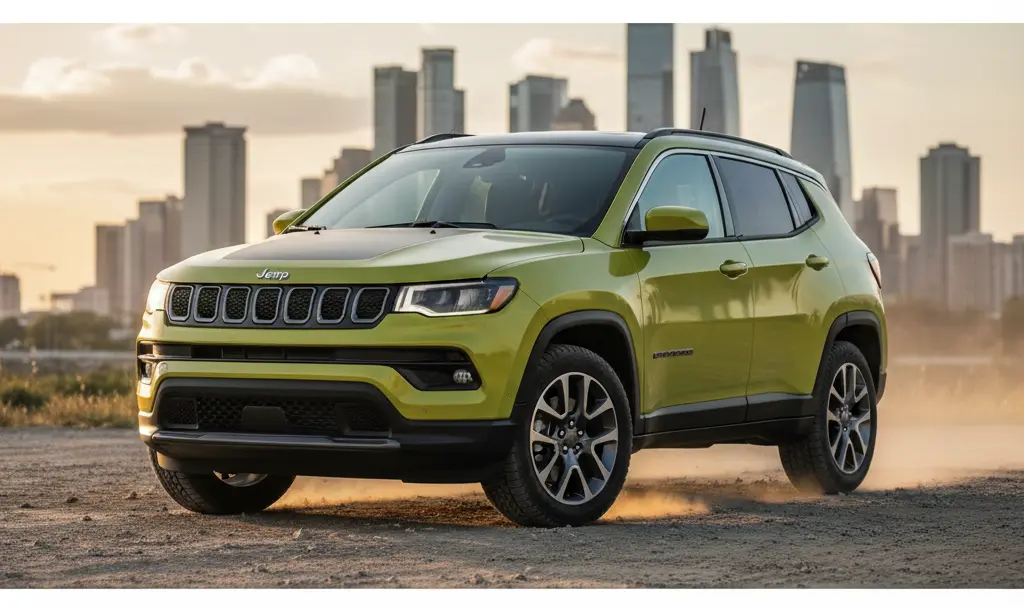
The vehicle’s angular silhouette immediately caught my attention, a welcome departure from the increasingly rounded, “soap bar” designs where aerodynamic efficiency often trumps styling originality. While the Compass may not be a hardcore off-roader, its appearance is undeniably “Jeep-like.”
Subtle details add character and appeal to those in the know. For instance, tiny, traditional Jeep off-road grilles are cleverly hidden in various places around the car, a delightful nod to its heritage.
The striking yellow-green paint finish in this configuration is particularly noteworthy. It’s one of those colors that genuinely elevates the car’s presence, making it hard to ignore.
Inside the Cabin: A Blend of Modern Tech and Tactile Controls
The interior of the new Compass is equally impressive. It strikes a perfect balance between cutting-edge modernity and practical, physical controls. Drivers will appreciate:
- Digital Instrument Cluster: A fully customizable display for essential driving information.
- Large 16-inch Touchscreen: An expansive, unusually proportioned central display for infotainment.
- Advanced Head-Up Display: This sophisticated system can project navigation directions as a full-fledged map directly onto the windshield, enhancing safety and convenience.
Despite its pursuit of modernity, the Compass doesn’t compromise on ergonomics. It retains physical buttons for climate control, a rubberized red drive mode selector (featuring Auto, Sport, Snow, and Mud settings), and a comfortable rotary shifter. There’s also a convenient physical button to disable the start-stop system and another dedicated button for driver-assistance systems (holding it mutes their operation), which is a thoughtful touch.
Driving Impressions: The New Jeep Compass in Motion
During the launch test drives, we covered over 60 miles in a variety of conditions, including city streets, expressways, and even some muddy terrain.
The car’s suspension tends to be on the firmer side, though not excessively so. It offers confident handling but doesn’t quite match the comfort levels of a related model from the Citroen stable, the new C5 Aircross, particularly on poorer road surfaces.
The steering system, however, leans heavily towards comfort. The power assistance is so pronounced that at low speeds, the steering wheel felt almost too light, which was surprising given the robust stereotypes associated with the Jeep brand.
Powertrain Options: Under the Hood
The engine lineup largely mirrors those found in analogous models from Stellantis brands like Citroen, Peugeot, and Opel. My test vehicle featured the base powertrain: a 1.2-liter 3-cylinder mild-hybrid engine producing 145 horsepower. This setup allows for short periods of coasting at low speeds with the internal combustion engine switched off, contributing to efficiency.
Subjectively, this engine performs admirably in urban environments. However, for highway driving, especially considering the Compass’s size, I would opt for something more powerful, as the current configuration feels a bit lacking in vigor on the open road.
Next in the lineup is a plug-in hybrid powertrain, offering 225 horsepower. This option comes with an approximate price increase of $10,000, leaving a noticeable gap in the middle of the range for those seeking a more potent internal combustion alternative without committing to a full plug-in hybrid.
For those considering an electric future, an all-electric variant is also available in three versions, differing in power output and battery capacity. The smaller battery offers a declared range of around 310 miles, while the larger battery extends this to approximately 400 miles.
The base gasoline version with 145 horsepower starts at just under $35,000 with promotional offers. While this entry-level price is appealing, choosing a more powerful option quickly escalates the cost.
The New Compass’s Biggest Omission: A Surprising Lack of 4×4
The Jeep brand is synonymous with off-road capability and 4×4 powertrains. For many, “Jeep” evokes images of adventure and exploration. As a core model in the lineup, the new Compass should ideally uphold these brand associations.
While it’s understandable for a base engine version to be front-wheel drive, and all-wheel drive typically requires an upgrade to a more powerful variant, the new Jeep Compass takes a different approach.
Here’s a breakdown of the available powertrains and their drive types:
- 1.2L 145 hp Mild-Hybrid Gasoline: Front-wheel drive
- 1.6L 225 hp Plug-in Hybrid: Front-wheel drive
- 74 kWh 213 hp Electric: Front-wheel drive
- 96 kWh 231 hp Electric: Front-wheel drive
- 96 kWh 375 hp Electric: All-wheel drive (4×4)
Looking for a classic gasoline Jeep Compass with a 4×4 powertrain? Unfortunately, you won’t find one—at any price. A more off-road-capable version is exclusively available with the most powerful electric variant, which is also slated for a later release.
Brand representatives indicate that the overwhelming majority of customers, when given the choice, opted for the front-wheel-drive version anyway. It seems that while many theoretically desire a 4×4 Jeep, few ultimately purchased such a configuration.
Despite this market insight, I believe a 4×4 option should still be available in the conventional lineup, if only to cultivate and maintain the iconic image of the Jeep brand. Without it, what we have is a well-equipped, modern, comfortable, and attractive vehicle. It features Jeep-inspired design cues and aesthetics, but the sole conventional gasoline engine in the range is a three-cylinder, and no version outside of the most powerful electric model offers 4×4. That’s a regrettable oversight.
Frequently Asked Questions (FAQ)
What is the starting price of the new Jeep Compass?
The new Jeep Compass starts from just under $35,000 for the base gasoline mild-hybrid version.
Does the new Jeep Compass offer an all-wheel-drive (4×4) option?
Currently, only the most powerful, top-tier all-electric variant (96 kWh 375 hp) of the new Jeep Compass will offer a 4×4 drive system, which is expected to be released at a later date. Conventional gasoline and plug-in hybrid models are exclusively front-wheel drive.
What are the available powertrain options for the new Jeep Compass?
The new Jeep Compass offers a 1.2L 145 hp mild-hybrid gasoline engine, a 1.6L 225 hp plug-in hybrid, and fully electric versions with 74 kWh (213 hp) or 96 kWh (231 hp and 375 hp) battery capacities.
Source: Gemini. Opening photo: Gemini
About Post Author
