

Contents
The Hidden Culprits: What Truly Ruins Your Charging Cables
Do you carefully coil your charging cable, only to find that it stops working after just a few months? The culprit isn’t your coiling technique—it is the basic laws of physics. In reality, users inadvertently destroy their cables through daily, seemingly harmless habits. Let’s explore what truly damages them, whether it is worth investing in premium materials, and how to find a cable that survives for years instead of weeks.
It Is Not the Coiling: The Physics of Cable Failure
For years, a myth has circulated on the internet claiming that chargers break primarily due to improper coiling—wrapping them too tightly, creating “balls” of wire around the power brick, or tossing them unprotected into a backpack.
However, experts from the Center for Advanced Life Cycle Engineering at the University of Maryland point out that laboratory tests reveal a different truth. Their controlled studies showed that standard coiling techniques on thin, flexible USB cables practically never cause failures on their own. During these tests, cables were systematically bent, stretched, and repeatedly plugged in and out. Researchers even analyzed the internal damage using X-rays, finding no definitive proof that “bad coiling” was the root cause.
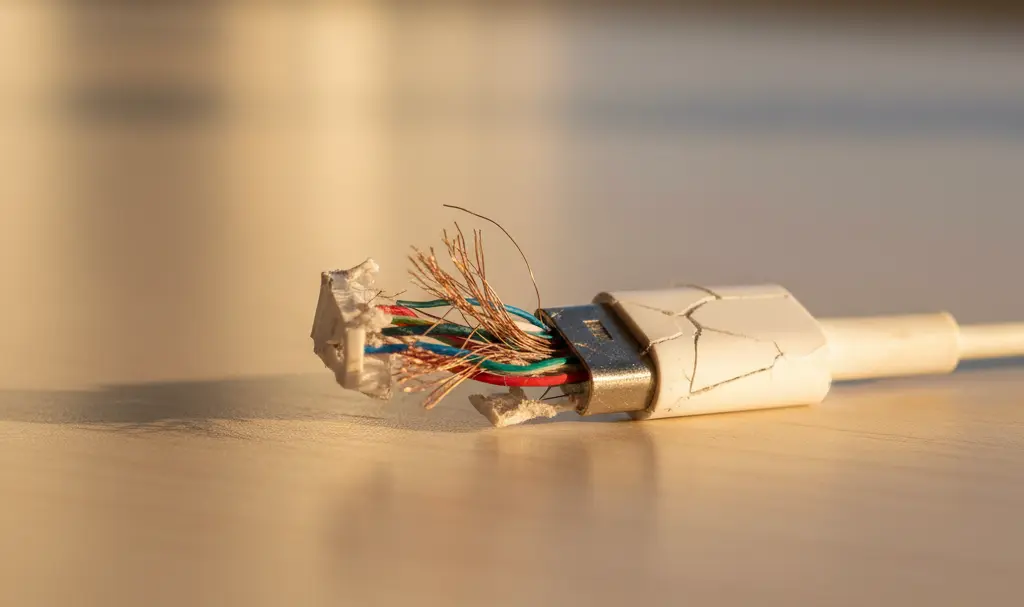
The real culprit is daily bending and yanking at the exact same pressure point—specifically where the wire meets the rigid plastic or metal plug. This junction is the weakest point in the entire design. Every time you yank the plug out by the cord, use your phone awkwardly in bed, or stretch the cable tightly across a room to reach a socket, the cable accumulates micro-damage. Eventually, it simply stops charging.
The Accumulation of Micro-Cracks
With every sharp bend of the conductive wire, a portion of the internal metal bends beyond its elastic limit, creating microscopic cracks and structural defects. When a cable is bent in the exact same spot day after day—usually right at the phone connector—the material gradually loses its structural integrity until the internal wires sever or the protective casing snaps.
This is the exact same physical phenomenon you observe when you bend a metal paperclip back and forth. It does not snap on the first movement; it breaks due to the accumulation of structural stress.
Bad Habits That Shorten Your Cable’s Lifespan
Over 90% of cable failures are the direct result of everyday use. Typically, cables are killed by repeated, seemingly innocent user habits. Some of the most common mistakes include:
- Pulling by the cord: Unplugging the charger by yanking the flexible wire instead of firmly gripping the solid plastic connector.
- Using the device while charging: Resting the phone on your chest or a desk in a way that bends the cable at a sharp, unnatural angle.
- Over-stretching: Forcing a short charging cable to reach the furthest corner of a room, keeping the wire under constant, high-tension physical stress.
In cars, an additional problem arises when a phone is placed in a cup holder or mount so that its own weight presses down directly on the charging port. Combined with the vibrations of driving, this causes continuous micro-impacts and high-stress fractures inside the connector.
Manufacturers and independent testing laboratories agree: in over nine out of ten cases, the daily usage method is responsible for failures, not an inherent flaw in the cable’s design. Stress tests consistently show that well-designed cables can withstand immense loads—provided the bending stress is distributed evenly across a longer section of the wire rather than concentrated entirely at the connector junction.

Materials Matter: Braided, Silicone, or PVC?
Publicly available durability tests for charging cables clearly demonstrate that not all cables are created equal. The materials used in construction make a massive difference in real-world longevity.
- PVC (Polyvinyl Chloride): In controlled experiments, standard plastic PVC cables typically begin to show signs of internal cracking after roughly 5,000 bending cycles. They are the cheapest to produce but are highly susceptible to abrasion. Furthermore, PVC can stiffen and snap in freezing winter climates.
- Silicone: Silicone USB-C cables are significantly softer, more pleasant to the touch, and highly flexible. However, this soft exterior makes them much more vulnerable to cuts, deep scratches, or accidental damage from sharp objects like keys.
- Nylon & Kevlar Braided: A nylon cable reinforced with Kevlar fibers can easily withstand upwards of 20,000 bending cycles. These offer the highest mechanical resistance. They survive being dragged across desk edges and being crushed in backpacks without compromising their protective casing or charging speeds.
These material differences translate directly to cost-effectiveness. Investing a few extra dollars in a premium cable pays off. It is highly recommended to purchase brand-name cables that feature official certifications (like USB-IF), an extended and flexible “strain relief” collar at the connector, and a braided nylon exterior.
How to Make Your Cables Last Longer
You do not need to obsess over advanced coiling techniques—that only really matters for thick, heavy-duty professional audio or video cables. Instead, focus on handling the connector area with care and purchasing robust equipment.
Best Practices for Cable Care
- Unplug properly: Always remove the charger by gripping the hard plastic or metal plug housing, never the flexible wire.
- Avoid sharp angles: Prevent the cable from bending sharply at 90-degree angles during active charging.
- Store safely: Loop the cable loosely (using a Velcro tie if possible) without creating tight knots or sharp kinks.
- Watch the temperature: Keep cables out of extreme environments. Scorching heat softens and melts the internal insulation, while freezing cold makes it brittle and prone to snapping.
If you notice the casing starting to weaken, you can preemptively reinforce the critical strain-relief areas with heat-shrink tubing or anti-bend cable protectors before the internal wires sever.
The Importance of a Quality Power Source
It is not just physical damage that ruins cables; cheap power bricks and voltage spikes play a huge role. Unstable power delivery can fry the tiny E-Marker chip embedded inside high-quality USB-C cables, instantly ruining their ability to fast-charge your devices. Always use certified chargers that comply with Power Delivery (PD) and Programmable Power Supply (PPS) standards.
Using a frayed or incompatible cable can lead to significant device errors. For instance, many users have reported issues akin to the Samsung Galaxy S26 Ultra charger compatibility issue, which often stems from unstable physical connections rather than the charging brick itself. Furthermore, as smartphones become smarter, a stable power connection is essential. Software advancements, such as the priority charging feature currently being tested by Google, rely heavily on uninterrupted, high-quality power delivery to function correctly.
Buying high-quality cables less frequently means generating less electronic waste—and, more importantly, it saves you from the frustration of waking up to a dead phone simply because your cheap charger gave up during the night.
Frequently Asked Questions (FAQ)
Does leaving a charging cable plugged into the wall degrade it?
Leaving a high-quality cable plugged into an outlet without a device attached does not significantly degrade the physical cable itself, as no active charging current is flowing. The real degradation comes from handling, bending, and pulling. However, it is always a good safety practice to unplug adapters when not in use to avoid phantom power draw and protect against unexpected electrical surges.
What is an E-Marker chip, and why does it affect cable durability?
An E-Marker (Electronically Marked) chip is a tiny integrated circuit found inside high-capacity USB-C cables (typically those rated for 60W, 100W, or 240W). It acts as a digital handshake between your device and charger to safely regulate power and data transfer. Unstable power surges from cheap, uncertified wall chargers can literally fry this chip, rendering the cable useless for fast charging—even if the physical braided exterior looks perfectly fine.
Is it better to use a longer charging cable to prevent damage?
Using a longer cable (like a 6ft or 10ft variant) can actually prevent damage if you frequently use your device while it is plugged in. A longer cable provides slack, drastically reducing the high-tension strain on the connector junction that occurs when you over-stretch a standard 3ft cable to reach your bed or couch.
Source: BBC, iFixIt, JMTJM, Energtechnica, BWOO, Allion & Opening photo: Gemini
About Post Author
