Contents
Apple’s AI Leap in Photography: What to Expect from the 2026 iOS Update
Apple is gearing up for one of the most significant overhauls to its Photos app in years. According to industry insider Mark Gurman, the major operating system update slated for fall 2026—widely referred to in recent leaks as iOS 27, alongside iPadOS 27 and macOS 27—will introduce a powerful new suite of tools powered by the Apple Intelligence platform. These upcoming features aim to help the iPhone finally close the noticeable gap in mobile AI photography currently dominated by Android rivals like Samsung and Google.
The New “Apple Intelligence Tools” Interface
Until recently, Apple’s foray into AI-driven photo editing has been relatively conservative, primarily offering the “Clean Up” tool designed to remove unwanted objects or photobombers from images. To streamline the user experience, Apple plans to consolidate its advanced editing capabilities into a dedicated interface section called “Apple Intelligence Tools.”
The goal is efficiency and user privacy. Each tool within this section is designed to execute complex photographic alterations in a matter of seconds. More importantly, Apple intends to process these AI tasks entirely on-device, a crucial move that protects user data and sets a privacy-focused benchmark compared to cloud-reliant competitors.
The upcoming photo app will reportedly feature three core tools:
- Extend: A generative background expansion tool.
- Enhance: A one-tap, AI-driven image correction system.
- Reframe: A spatial perspective alteration feature.
This massive leap in built-in photography software is expected to be a core pillar of the broader WWDC 2026 AI advancements.
Extend: Generative Background Expansion
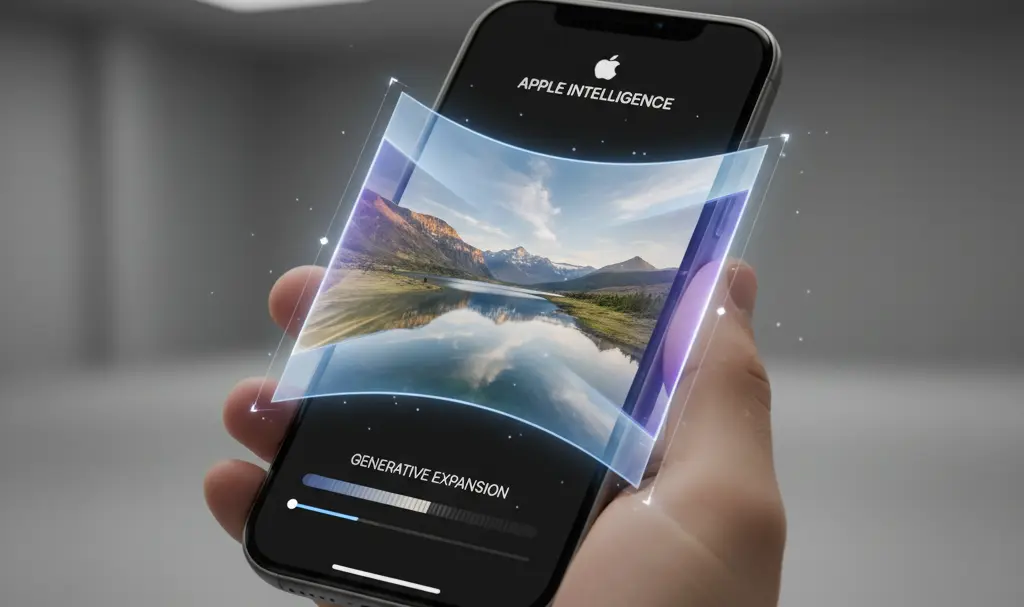
The Extend feature will empower users to generate additional image content beyond the original boundaries of a photograph. By simply dragging the edge of a photo with a finger, users can command the AI to realistically fill in the missing background. A practical example would be taking a tight, close-up shot of a famous monument and using “Extend” to seamlessly generate and flesh out the surrounding sky and landscape, similar to Google’s Magic Editor or Adobe’s Generative Expand.
Enhance: One-Tap Image Correction
While basic auto-adjustment features already exist in mobile photo apps, Enhance takes this a step further by leveraging deep machine learning for automatic, intelligent correction of colors, lighting, contrast, and subtle image parameters. Operating as a single-tap solution, it removes the friction of manually tweaking individual sliders, ensuring that everyday snapshots instantly look professionally graded.
Reframe: Changing Perspective for Spatial Photos
Reframe is arguably the most unique addition to the lineup, designed specifically to take advantage of spatial photos (3D-depth imagery captured by newer iPhone models and the Apple Vision Pro). Because spatial photos contain intricate depth data, Reframe allows users to retroactively shift the perspective of the image after it has been taken. For instance, if a subject was photographed slightly from a profile angle, the Reframe tool could virtually shift the camera angle to view the subject more from the front.
Development Hurdles and the Road to WWDC 2026
Despite the ambitious roadmap, these AI capabilities might not all be ready on day one. Current reports suggest that Apple’s engineering teams are still struggling to refine the Extend and Reframe tools to meet the company’s strict quality standards. There is a distinct possibility that these features could be delayed or shipped in a reduced capacity compared to their original conceptualization.

The 2026 iOS update is expected to be officially unveiled at the WWDC 2026 conference, projected for June 8, 2026. Its public release will likely follow in September of the same year, perfectly aligning with the highly anticipated debut of Apple’s first foldable iPhone.
In addition to photography, Apple’s software development for 2026 is anchored by two main pillars: a massive expansion of the Apple Intelligence ecosystem—including a ground-up reconstruction of Siri detailed in Apple’s Siri AI strategy and LLM integration—and deep system code optimizations to enhance overall performance, boost battery life, and eliminate lingering bugs.
Frequently Asked Questions (FAQ)
How does Apple’s on-device processing for AI photo tools compare to cloud-based alternatives?
Apple’s focus on on-device processing means that operations like Extend and Enhance are executed entirely on your iPhone’s Neural Engine. This drastically improves user privacy, as your personal photos are never uploaded to a remote server for processing. It also enables the tools to work without an active internet connection, though it does require substantial local hardware power compared to cloud-reliant tools.
What exactly are “spatial photos” and why do they matter for the Reframe tool?
Spatial photos are specialized images captured by advanced camera hardware (like the dual-lens setup on modern iPhone Pro models) that record 3D depth data alongside standard color information. The Reframe tool uses this depth map to understand the physical volume of the subjects in the photo, allowing the AI to mathematically shift the viewpoint and “see” slightly around objects, a feat impossible with standard flat 2D imagery.
Will older iPhone models be capable of running these new Apple Intelligence tools?
Due to the heavy computational demands of advanced on-device generative AI, it is highly likely that features like Extend and Reframe will be restricted to newer hardware. Devices will need advanced A-series chips with powerful Neural Engines (such as the A17 Pro or newer) to generate realistic pixels and process 3D depth data efficiently without draining the battery.
Source: MacWorld, MacRumors, Peta Pixel, 9to5 Mac
Opening photo: Gemini
About Post Author