

Contents
The Hidden Network: Inside the “Jungle Internet” and Animal Social Media
When we step into nature, the chorus of animal sounds often feels like a peaceful escape from the constant buzz of smartphones, artificial intelligence, and unread emails. However, for the animals themselves, this acoustic environment is not just soothing background noise. It is a highly active, life-saving information network.
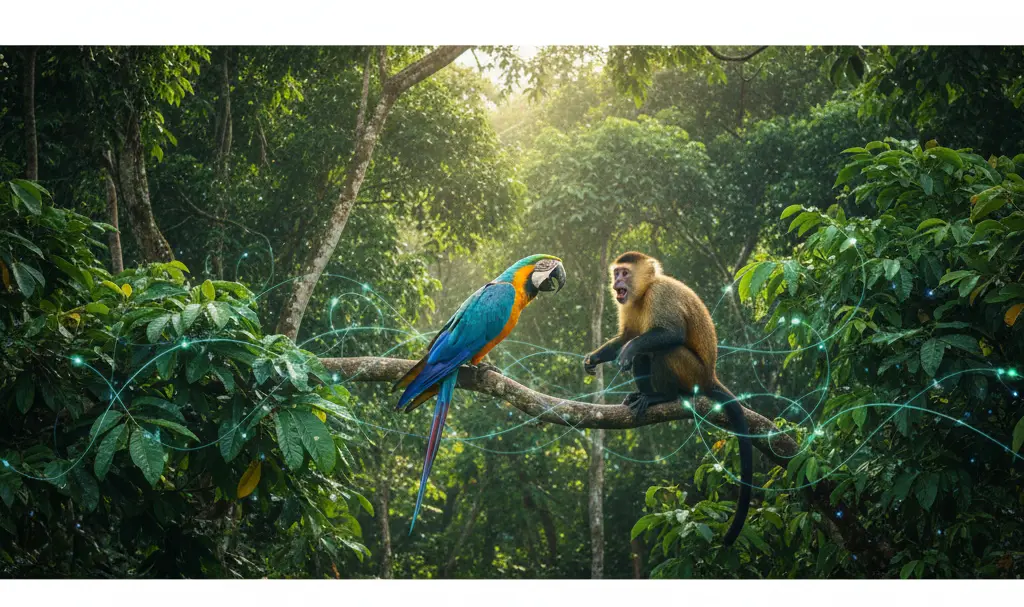
While we often discuss how the internet is no longer just for humans, bots, and AI generate significantly more traffic in our digital realm, the natural world has been running its own complex, high-speed network for millennia. Recent research conducted by scientists from the United States and Australia has proven that this “jungle internet” is actively functioning, transmitting vital warnings across different species.
Setting Up an Unconventional Experiment
To understand exactly how information flows through a dense rainforest environment, researchers needed a way to trigger natural alarm systems without causing permanent distress. They turned to an ancient practice: falconry.
Scientists from the University of California, USA, and Deakin University, Australia, brought trained birds of prey into the Peruvian Amazon. By flying these predatory birds through the forest, the research team successfully triggered a natural chain of information-sharing among the local wildlife.
- Recording the Initial Alerts: As the birds of prey flew over, the team recorded the immediate alarm calls emitted by local primates and tropical birds.
- Testing the Network: The researchers then replayed these specific recordings through hidden speakers to observe how other animals in the Amazon reacted to the artificial warnings.
- Mapping the Spread: By documenting which species ignored the sounds and which ones amplified them, scientists mapped the flow of data through the ecosystem.
Which Animals Are the “Super-Sharers” of the Jungle?
In the human digital world, some users constantly share posts while others quietly observe. The animal kingdom operates similarly. Just as some internet users relate to the psychology of social media lurkers making conscious choices for digital well-being—opting to read without reacting—many animals choose to stay silent to avoid revealing their location.
However, the experiment revealed distinct “super-sharers” that actively broadcast warnings to their neighbors. According to the researchers’ report, specific bird species were the most reliable nodes in this network:
- Black-fronted nunbird (Monasa nigrifrons): One of the most active participants, frequently echoing the alarm calls to surrounding wildlife.
- White-fronted nunbird (Monasa morphoeus): Similarly critical in ensuring the warning reached further into the forest.
Among mammals, primate species also demonstrated a high propensity to hit the “share button” on these survival alerts. Capuchin monkeys (Cebus) and spider monkeys (Ateles) showed a strong, albeit slightly lower, inclination to echo the alarm signals compared to the nunbirds.
The Importance of the Forest Canopy
Interestingly, the study highlighted a significant geographical divide within the forest itself. Alarm calls originating from animals living on the darker, denser forest floor were replicated far less frequently. The true high-speed “internet of the jungle” flows most intensely through the forest canopy.
Up in the treetops, sound travels further without being muffled by thick undergrowth. Canopy-dwelling species act as the biological equivalent of cell towers, ensuring that warnings about approaching eagles or jaguars are broadcast far and wide.

Beyond Mating Calls: The Language of Survival
It is a common misconception that animal vocalizations are primarily tied to mating seasons or territorial disputes. In reality, everyday chirps, hoots, and calls form a sophisticated social media feed dedicated to community safety.
Equally important is the deliberate use of silence. When the jungle suddenly goes quiet, it is often the most profound signal of all. A sudden drop in acoustic activity usually means a predator is dangerously close, prompting the entire surrounding area to freeze in absolute stillness to avoid detection.
Frequently Asked Questions (FAQ)
Why do canopy-dwelling species transmit alarm calls more frequently than ground-dwelling animals?
Canopy-dwelling species act as the primary broadcasters because sound waves travel much further and with less interference high above the ground. The dense foliage, tree trunks, and underbrush of the lower forest absorb and muffle sound. Additionally, animals in the canopy often have a better vantage point to spot aerial and approaching terrestrial predators, making their warnings highly valuable to the rest of the ecosystem.
Can different animal species actually understand each other’s specific alarm calls?
Yes, this phenomenon is known as “interspecific eavesdropping.” Many animals have evolved to recognize the specific distress or alarm calls of entirely different species sharing their habitat. Recognizing a neighbor’s warning saves energy and provides an early warning system, significantly increasing an individual’s chances of evading a shared predator.
Does the “jungle internet” differentiate between types of threats, or is it just a general panic signal?
Many species utilize highly specific vocalizations depending on the type of threat. For instance, primates and birds often have distinct calls for an aerial predator (like an eagle) versus a terrestrial predator (like a jaguar or snake). This specific data dictates the evasive action taken by the listeners—whether to drop to the lower branches or climb higher into the canopy.
Source: The Conversation / Current Biology. Opening photo: Gemini
About Post Author
