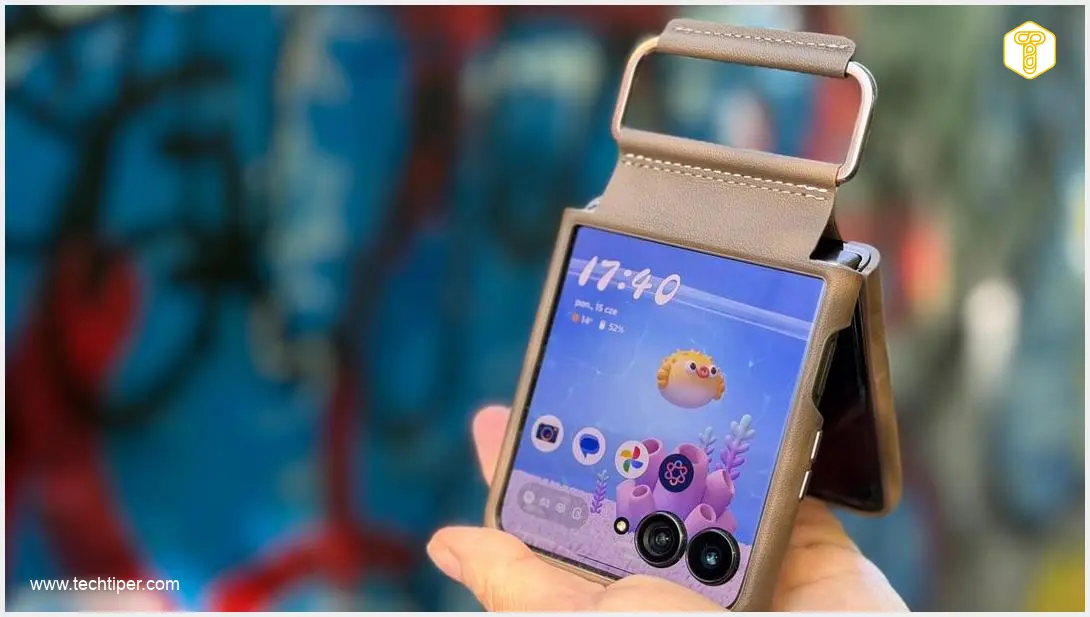
Motorola Razr 70 Ultra Review
-
Design and Build Quality
-
External Display Functionality
-
Internal Display Quality
-
Battery Life & Charging
-
General Performance
-
Camera Capabilities
A Premium Flip Phone with Refined Features and a High Price Tag
The Motorola Razr 70 Ultra impresses with its superb design, functional external display, vibrant internal screen, and excellent battery life with fast charging. While offering strong daily performance and capable cameras, it features only incremental upgrades from its predecessor and can experience thermal issues under heavy load. Its high price point and older USB-C standard are notable drawbacks.
Advantages
- Superb Design and Build Quality
- Compact Folded Dimensions
- Functional External Display
- Fast Charging (68W wired, 30W wireless)
- Solid 5000 mAh Battery
- Powerful Specifications
- Dual AMOLED Displays with 165 Hz Refresh Rate
- New LOFIC Sensor in Main Camera (improved dynamic range)
- Innovative Camera Gesture (zoom during video recording)
- Android 16 with Clean Moto Overlay
Disadvantages
- Minor Upgrades from Razr 60 Ultra
- Temperature Management Issues (heating under heavy load)
- No Telephoto Lens
- Older USB-C 2.0 Standard
- Limited Software Update Support
- IP48 Rating (less dust protection)
- Moto AI Features (useful but not groundbreaking)
- High Price Point
Contents
Motorola Razr 70 Ultra Review: The Best Flip Phone on the Market, if You Ignore the Price
The Motorola Razr 70 Ultra is a smartphone that refines a proven formula. This compact foldable features a highly functional external display, robust specifications, and some of the fastest charging capabilities in its segment. If you’re experiencing déjà vu, it’s understandable – but is this assessment unfair? Join us for an in-depth review of the Motorola Razr 70 Ultra. Motorola has made subtle but meaningful advancements with this model. The latest Razr 70 Ultra boasts a larger battery, a new camera sensor, and a slightly brighter screen. For more details on its evolved design and specifications, you can explore the Motorola Razr 70 Ultra: Thicker Design, Improved Specs. While these aren’t revolutionary changes that will redefine the market, they contribute to a more polished user experience. As the foldable market continues to evolve, future iterations like those discussed in Motorola Razr Fold: Release Date, Specs, Price 2026 promise further innovation. Does this mean the phone should be overlooked? Absolutely not. The Razr 70 Ultra remains one of the best foldable smartphones in the flip format – refined, elegant, thoughtfully designed, and exceptionally pleasant for daily use.Advantages
- Superb Design and Build Quality: Crafted with premium materials, offering a luxurious feel.
- Compact Folded Dimensions: Easily fits into pockets and small bags.
- Functional External Display: Allows full phone operation without unfolding, enhancing convenience.
- Fast Charging: Features 68W wired and 30W wireless charging.
- Solid Battery: Equipped with a 5000 mAh battery for extended use.
- Powerful Specifications: Ensures smooth performance across all tasks.
- Dual AMOLED Displays with 165 Hz Refresh Rate: Offers vibrant visuals and ultra-smooth scrolling.
- New LOFIC Sensor in Main Camera: Enhances dynamic range for superior photos.
- Innovative Camera Gesture: Allows for zoom during video recording with a simple tilt.
- Android 16 with Moto Overlay: A clean and efficient user interface with useful enhancements.
Disadvantages
- Minor Upgrades from Razr 60 Ultra: Changes are incremental, leading to a sense of familiarity.
- Temperature Management Issues: Prone to heating under heavy load.
- No Telephoto Lens: Lacks optical zoom for distant subjects.
- Older USB-C 2.0 Standard: Limits data transfer speeds.
- Limited Software Update Support: Shorter update window compared to some competitors.
- IP48 Rating: Offers less dust protection than the IP68 standard found in many non-foldables.
- Moto AI Features: Useful but not groundbreaking.
- High Price Point: A significant investment for the incremental improvements.
Unboxing the Motorola Razr 70 Ultra
The Motorola Razr 70 Ultra arrives in an elegant black box. Its contents are typical for a premium smartphone – meaning you won’t find a charger included. Instead, the package contains a selection of paperwork, a USB cable, and a soft case with a grip. This approach is common among high-end devices, encouraging consumers to reuse existing chargers or purchase one separately.Design and Build Quality
Motorola has consistently designed phones that feel like jewelry – beautiful, refined, and pleasant to touch, yet practical, functional, and durable. The manufacturer emphasizes unique finishes and unconventional colors, a trend seen across both its budget-friendly and high-end models. The brand often collaborates with Pantone, utilizing its color palette for original materials and distinctive hues. This philosophy extends to the Razr 70 Ultra, which is available in two color variants, differing not only in shade but also in finish material. The Pantone Cocoa version features a back covered with natural wood veneer, while the Pantone Orient Blue option opts for Alcantara. Both finishes are more than just aesthetics; they offer distinct tactile experiences that immediately differentiate this phone from its plastic-clad competitors. The overall appearance and silhouette are nearly identical to its predecessor, the Razr 60 Ultra. When folded, it measures 15.69 mm thick, expanding to 7.19 mm when unfolded. It weighs precisely 199 grams. These dimensions and weight are almost directly carried over from the Razr 60 Ultra. For anyone upgrading from the previous generation, the design differences are practically invisible – the only distinction being a slightly darker shade of the brown finish. The metallic frames exude elegance, and the hinge operates smoothly – neither too loose nor too stiff. The phone doesn’t close spontaneously when unfolded, nor does it feel like it’s about to collapse. On the side edges, you’ll find the volume buttons, the power button integrated with a fingerprint reader, and a dedicated button to activate AI functions. This AI button is a new addition to the foldable smartphone. The bottom of the casing houses a USB-C connector (unfortunately still using the older 2.0 standard), a speaker, and a SIM card tray. The device boasts an IP48 certification, offering protection against water immersion and dust to a limited extent. This is less than the IP68 rating offered by many non-foldable smartphones. Practically, the phone should comfortably survive rain, a spilled drink, or accidental immersion, but caution is advised with sand or other solid particles, as the internal screen and hinge mechanism are most vulnerable. The hinge itself appears very robust. After two weeks with the smartphone, no looseness or creaking developed. It will be interesting to see how it holds up after several months or years. Additionally, the external screen is protected by Gorilla Glass Ceramic, which is crucial as this part of the phone is most susceptible to damage, especially when carried in a pocket, bag, or backpack.Dual Dynamic Displays
The Razr 70 Ultra is distinguished by its two impressive screens. The external display is a four-inch LTPO AMOLED panel with a resolution of 1080×1272 pixels and a density of 417 PPI. This isn’t just a basic notification panel; it’s a fully functional display that covers almost the entire outer flap, surrounding the camera lenses. Touch response is instantaneous, and the saturated colors and deep blacks create an excellent visual experience. With a peak brightness of 3000 nits, it remains perfectly readable even in direct sunlight. Moreover, the external screen allows you to perform nearly any task without opening the phone: respond to messages, use navigation, browse Spotify playlists, and even play games. In this aspect, Motorola holds a significant advantage, offering a much more functional external screen experience. The main internal screen is a foldable 7-inch LTPO AMOLED panel. Its resolution of 1224×2992 pixels at a density of 462 PPI delivers a sharp, detailed image. The refresh rate reaches up to 165 Hz, though in practice, this high value is only utilized in a few select games. The most significant upgrade from its predecessor is the increase in peak brightness from 4500 to 5000 nits, making this one of the brightest screens in the segment. HDR10+ and Dolby Vision support are the cherries on top. The crease in the middle of the screen, where the hinge is located, is a common characteristic of all foldable smartphones. While less visible, it is tactile, but during everyday use, it quickly becomes unnoticeable.Software and AI Features
The Razr 70 Ultra launches with Android 16 and Motorola’s Moto overlay. Traditionally, Moto’s interface has been one of the “cleaner” Android experiences, though recently the manufacturer has added more bundled software. In this instance, during initial setup, Motorola prompts the installation of apps like Adobe Scan, Opera, Perplexity, Microsoft Copilot, and LinkedIn. This is in addition to Google’s applications and services, as well as Motorola’s proprietary software, which includes various personalization and gesture-based features. For example, a double twist of the wrist opens the camera, a shake turns on the flashlight, and tilting the phone during recording zooms the image. Security features are managed via Moto Secure, parental controls through Family Space, and Smart Connect links the phone with a computer. Numerous personalization options for interface layout, fonts, icon shapes, and color themes are available. An interesting addition is Style Sync: simply snap a photo of your outfit, and the AI will suggest a wallpaper that matches your clothing’s colors and textures. You can also generate wallpapers via text description (Magic Canvas) and animate static photos to create dynamic, moving backgrounds. It’s worth noting that both screens can be customized independently. The external display supports dedicated widgets, panels, and animated wallpapers specifically designed for its smaller format. Interestingly, it offers more options than the larger internal screen, which enhances its functionality without needing to unfold the phone, especially given its generous size. Naturally, Artificial Intelligence is a core component. Motorola integrates it through Moto AI, a suite of AI features including an assistant, call summaries, AI-generated wallpapers, and selfie analysis. There’s nothing indispensable or groundbreaking here; it’s more a collection of useful enhancements rather than a revolution in phone interaction. For many users who prefer not to have AI dictating their phone experience, this could be a significant advantage. Another crucial topic is the update policy. The support period is shorter than what you’d find with Samsung or Google devices. Motorola commits to three Android updates and five years of security support. This will be an important consideration for buyers with a long-term perspective.Cameras and Photography Capabilities
In terms of photography, Motorola has relied on proven solutions with one key improvement. The main 50-megapixel camera, featuring an f/1.8 aperture, optical image stabilization (OIS), and PDAF, now includes a new LOFIC (Lateral Overflow Integration Capacitor) sensor. According to Motorola, this technology increases dynamic range up to sixfold, resulting in better detail preservation in both bright and dark areas of a photo. While a direct comparison with the previous model isn’t possible here, you won’t be disappointed with the Razr 70 Ultra’s photographic output. Photos taken in good lighting conditions are vibrant and lively, with accurately rendered skin tones and a natural color palette (Pantone validated). The effectiveness of OIS is also commendable. The new sensor also performs admirably in challenging low-light conditions. The ultrawide-angle camera, with an f/2.0 aperture and a very wide 12mm angle, is a reliable tool for capturing landscapes and architecture. The quality of ultrawide-angle photos is good (though less so at night), though a closer inspection reveals slightly less detail compared to the main camera. Do not expect optical zoom; the Razr 70 Ultra lacks a telephoto lens. Instead, it relies on digital zoom, which should ideally not be used beyond 2x magnification to maintain image quality. Selfies can certainly be taken with the main cameras, offering superior results. There is also a convenient internal 50 Mpx selfie camera, but it is noticeably weaker than the main rear cameras, making the latter a preferred option for higher quality self-portraits. In terms of video capabilities, the Razr 70 Ultra delivers what you would expect from a 2026 flagship foldable, though without major surprises compared to its predecessor. The maximum recording mode is 8K at 30 frames per second, available exclusively with the main lens. However, all three lenses (main, ultrawide, and internal selfie camera) can record in 4K. An interesting new feature in camera mode allows for smooth zooming during video recording by simply tilting the phone, without touching the screen or using a pinch gesture. A gentle tilt engages the zoom smoothly and slowly, with image stabilization remaining effective if the movement is careful.Connectivity and Communication
The Razr 70 Ultra is a full-fledged flagship in terms of connectivity. The phone supports 5G NR, Wi-Fi 7, and Bluetooth 5.4 with high-quality codec support, translating to stable connections with wireless headphones and rapid data transfer over a home network. NFC is also included, useful for mobile payments and quick accessory pairing. An intriguing addition is UWB (Ultra-Wideband) – a technology enabling precise location tracking of other devices or compatible trackers. For navigation, the smartphone utilizes five systems: GPS, GLONASS, Galileo, QZSS, and BeiDou, ensuring faster and more accurate positioning, even in challenging urban environments. The Razr 70 Ultra also supports dual SIM through a nano SIM + eSIM configuration, simplifying the separation of business and personal numbers without needing physical card swaps. However, there are a few disappointments. The USB-C port still operates on the older 2.0 standard, meaning slower data transfer speeds when connected via cable. The 3.5mm headphone jack is also absent, though this has become standard in this segment. Fortunately, voice call quality and 5G network stability during testing gave no cause for complaint – the phone maintained signal equally well in urban areas and outside the city.Performance, Memory, and Thermals
At the heart of the Razr 70 Ultra is the Qualcomm Snapdragon 8 Elite processor – the same chip found in the Razr 60 Ultra. While Motorola has slightly increased the clock speed from 4.32 GHz to 4.47 GHz, this change is practically unnoticeable to the user. The configuration is rounded out by 16 GB of LPDDR5X RAM and 512 GB of UFS 4.0 internal storage. The Snapdragon 8 Elite is still a powerful, top-tier Qualcomm processor, but it belongs to the previous generation of chips. When paying a premium price for a new smartphone, one expects the latest processor. Nevertheless, even with an older CPU, the Motorola Razr 70 Ultra performs excellently with daily tasks, multitasking, and most games. Using the Razr 70 Ultra as a primary phone for over two weeks, it proved to be a highly enjoyable device. The Android 16 system with its custom overlay operates quickly, smoothly, and efficiently. Everything ran without the slightest stutter, including more demanding games. However, it’s impossible to ignore the smartphone’s strong tendency to heat up. This was noticeable during initial benchmarks, specifically extreme condition tests in the 3D Mark application. Due to rising temperatures, the smartphone was unable to complete these tests, with temperatures sometimes exceeding 55 degrees Celsius. Fortunately, such extreme heating did not occur in daily use, even during intensive work – it was limited to demanding synthetic tests. Temperatures during extended gaming sessions in Call of Duty Mobile and Asphalt Legends did not exceed 41 degrees. While it got warm, it wasn’t uncomfortably so. The 3D Mark tests, which verify the processor’s ability to maintain consistent performance under prolonged load, were inconclusive due to thermal issues. Therefore, the CPU Throttling Test app was used to assess the Snapdragon’s behavior. The results were concerning: the smartphone rapidly throttled the processor within the first few minutes, with performance dropping to 43-52%.Battery Life and Charging
Battery capacity is one of the changes that indicate a step forward for the new foldable Motorola. The battery has increased from 4700 mAh to 5000 mAh. While this is only a 6% increase, combined with an efficient processor and optimized software, it can yield tangible gains in operating time. Thirty minutes of playing Call of Duty consumes approximately 7% of the battery, and about 15% of the battery disappears after two hours of watching a movie on Prime Video. Half an hour of navigation translates to about 5% battery consumption. The battery easily lasts a full day of use – Motorola states up to 36 hours of operation on a single charge under standard usage conditions. Support for 68-watt TurboPower charging means the battery replenishes to 50% in just 20 minutes, with a full charge taking approximately 55 minutes. This provides a clear advantage over some competitors, which may require around 90 minutes for a full charge. As mentioned, the appropriate charger is not included in the box and must be purchased separately. However, wireless and reverse wireless charging capabilities are present.Motorola Razr 70 Ultra Specifications and Pricing
Here are the specifications for Motorola’s latest foldable:- System: Android 16
- External Display: 4.0-inch Extreme AMOLED, 1272 x 1080 pixels resolution, 3000 nits peak brightness (500 default), Corning Gorilla Glass Ceramic, Dolby Vision, HDR10+
- Internal Display: 6.96-inch Extreme AMOLED, 1224 x 2992 pixels (1.5K) resolution, 22:9 aspect ratio, up to 165 Hz refresh rate, 5000 nits peak brightness (500 default), Pantone Validated, Dolby Vision, HDR10+
- Processor: Snapdragon 8 Elite, Octa-core Oryon processor (2 high-performance cores + 6 efficiency cores), up to 4.47 GHz clock speed, TSMC 3nm process, Qualcomm Adreno 830 GPU
- RAM: 16 GB LPDDR5X
- Internal Storage: 512 GB UFS 4.0
- Cameras:
- Main: 50 MP, ƒ/1.8, 1/1.56″, OIS, Pantone Validated
- Ultrawide: 50 MP, ƒ/2.0, 122° field of view, 1/2.93″
- Internal Selfie: 50 MP, ƒ/2.0, 1/2.93″, 89.3° field of view, 1.28 μm pixel size
- Connectivity: 5G NR, UWB, Wi-Fi 7, USB Type-C (USB 2.0), NFC, Bluetooth 5.4, nano SIM + eSIM
- Navigation: GPS, GLONASS, Galileo, QZSS, BeiDou
- Other Features: Side-mounted fingerprint sensor (FPS), Stereo speakers with Dolby Atmos, Face unlock, AI Key, Moto Actions, IP48 rating
- Battery: 5000 mAh silicon-carbon, Over 36 hours on a single charge, 68W wired charging, 30W wireless charging, 5W reverse wireless charging
- Dimensions: 88.12 × 73.99 × 15.69 mm (closed), 171.48 × 73.99 × 7.19 mm (open)
- Weight: 199 g
Conclusion and Our Verdict
With the Razr 70 Ultra, Motorola seems to operate on the principle that a good phone doesn’t need to change drastically every year. There’s much truth to this. The Razr 70 Ultra is genuinely good. Users will appreciate its excellent and practical external screen, the quality of its craftsmanship, material choices, and solid battery life. The device operates quickly and smoothly, the Hello UI interface is aesthetic, user-friendly, and not overburdened with AI, complemented by numerous personalization options and proprietary gestures. There are certainly many reasons to like the Razr 70 Ultra. These advantages outweigh the disadvantages (e.g., thermal management and processor throttling), but they don’t erase a fundamental issue. The Razr 70 Ultra is an excellent, but expensive, phone – especially when compared to last year’s Razr 60 Ultra, from which it does not significantly differ. If you desire it, you can purchase it at its launch price and enjoy it immediately. Alternatively, you can wait for its price to drop – which is inevitable. Or, consider acquiring the previous version, the Razr 60 Ultra, for a substantially lower cost, accepting slightly shorter update support.Frequently Asked Questions (FAQ)
The Motorola Razr 70 Ultra features a slightly larger 5000 mAh battery (up from 4700 mAh), a new LOFIC sensor in its main 50 MP camera for improved dynamic range, and a slightly brighter internal display (5000 nits peak brightness). While these are incremental, they contribute to a more refined user experience.
The Razr 70 Ultra boasts a highly functional 4-inch LTPO AMOLED external display that covers almost the entire outer flap. This allows users to perform nearly any task – respond to messages, use navigation, play music, and even games – without needing to unfold the phone, greatly enhancing convenience and usability.
During synthetic benchmarks, the Motorola Razr 70 Ultra showed a tendency to heat up significantly, with temperatures exceeding 55 degrees Celsius, leading to processor throttling where performance dropped to 43-52%. However, in typical daily use and even during extended gaming sessions, temperatures remained at a more comfortable level (around 41 degrees Celsius), suggesting that extreme overheating is primarily limited to intensive synthetic load tests.
About Post Author